
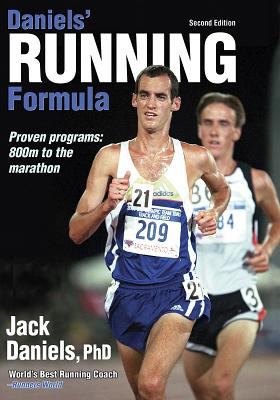
Since I started running seriously in 2010, I’ve bought and read a dozen books on running. Of those twelve, I’ve gifted, given away, or otherwise tossed eleven of them. This is the book that remains. Because it shows me, based on data acquired through the author’s experience using the scientific method, exactly where I succeed and where I fail.
Not that the other books were all bad. Most offered much needed advice, motivation and methods for training and running races from the 5k to the marathon. The authors of those books told me that I could accomplish things, and even demonstrated how to do so. What they couldn’t tell me was why.
Why is the vast majority of my training running long and slow? Why does running this pace for my tempo runs benefit me and that pace doesn’t? Repetitions, Intervals, and Tempo Runs? And most importantly why am I not getting faster?
Because, the book explained to me (in a manner of speaking), you are not yet able to train for a faster marathon pace than you are capable of running right now.
That was a tough pill to swallow. We all had coaches, teachers and parents attempt to motivate us at whatever we were struggling with by saying “just get better!”. It worked just well enough to perpetuate the myth that you can convince yourself that you can do anything, as long as you believe you can do it.
But the fact is that when you set a goal to improve on something, whether it be a sport like running or any worthwhile endeavor, you have to start where you are.
And Daniels’ Running Formula does what few books can: it tells me how fast a runner I am… right now.
You see the term VDOT all over the running literature these days. Thank Jack Daniels for that. It was his years of research and testing a broad spectrum of runners that brought the term into the running consciousness. In broad strokes, the VDOT is the amount of oxygen an athlete uses while running. Within a bit of variability due to running economy (which can be improved with practice), it puts a number on your current fitness to run a race. The higher the number, the faster you can run, as long as you put in the right kind of training.
Your VDOT is easy to calculate: run a specific distance as best you can (anywhere from 1 mile to a marathon, though in my experience a 10k or half marathon appears to be most accurate), and look up your time in a VDOT table available in Daniels’ book or any one of several hundred sites online. That’s your number. That’s your anchor. That’s where you start. There are training paces for various workouts associated with that number. Set your training plan and get to work.
When this fact finally dawned on me, I almost wept. Not because I had discovered the Holy Grail, but because all those “you can do anything you set your mind to” myths howled out of me in agony. How do I get faster in the future if I train for the pace I’m capable of running now? Why can’t I just train at the paces associated with the speed I aspire to?
Sure! Why not? Another part of me replied. And I can get sick, injured, irritable, lose sleep, get hurt, and defeat the entire purpose of training in the first place. Set to! Enjoy!
If training depended entirely on pace, the impatient part of my brain would be right on. But it’s not just pace that gets you to your goal; it’s consistency. I know runners who have knocked an hour off their marathon times within the few years that I have known them. Why? Because they learned the lesson I am finally learning now. Start where you are. Run the paces that strengthen the ability you currently have, and train consistently.
In the next post, I will talk about the race I ran last weekend that gave me my current VDOT. If I follow my own advice, start where I am, and train consistently, I will find that, in spite of my self doubt, I will have become a faster runner. My next race will prove it.
I’m on my way. As are we all.
So: Where am I?
 Quest To Qualify
You must be logged in to post a comment.