
I’m not old. Really, I’m not. When I was in high school, I perceived that adults just a few decades older than me were old and out of touch. But that couldn’t possibly apply to me.
Right?
Here I am, a “man of a certain age,” if you will, two decades older than most of the adults I knew when I was in high school. At an age of such a towering height that I never thought I’d actually get there back in my sepia toned youth.
Life moves along like a mighty river, doesn’t it?
There comes a point where, after you’ve owned that shiny new car for long enough that the paint begins to fade a bit and the new car smell is a distant memory, that a little red light appears in a previously unnoticed corner of the dashboard where the speedometer lives. It’s called the Check Engine light, and the message behind the persistent little reminder carries a cryptic message. The message is this:
“THE FUTURE IS NOW, M—–F—–!”
There was a brief moment of about eight years duration when I thought I would live forever. Looked about the same, felt about the same, had about the same amount of energy, but over time, little changes made their way through the spiraling DNA that encodes me. I didn’t notice it until one day I realized that I couldn’t read small print on the page. Time to grab a pair of +1.5’s from CVS and accept the fact that I’m my grandmother now. Yikes!
Marathon running has chased back a great deal of the entropy that will eventually encase us all in its comforting coffin, but every once in a while, something slips through. In my case, it was heart palpitations.
Mostly harmless, my primary care physician told me. No doubt your run of the mill stress brought on by the usual suspects: job, city living, social concerns, concerns about the future. Terms like diet modification, self care and meditation were thrown around.
After informing my physician of my family’s history of heart ailments (father and grandfather both passing away from failure of that vital organ), he prescribed a series of tests designed to ferret out how my body is holding up, since I am pretty much halfway and change between birth and the heat death of the Universe.
One of these tests is called a “Holter Monitor,” and it looks exactly like this:
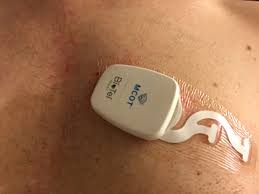
The monitor is a chip approximately the size of a USB drive. It is attached to the chest by plugging it into a cartridge which itself is attached to a plastic adhesive patch. Once on the chest, it monitors your heart beats over a two week period. Once the two weeks are up, I will mail the monitor to a processing facility that will download the data and send it along to a cardiologist, who will then forward any findings to my primary care physician.
And I get to wear this thing for two weeks! Yay!
Luckily, since I am in the final training cycle for the California International Marathon, I can wear it while running.
“Of course,” the technician said as he demonstrated how to attach it to my chest, “you can’t really wear this while running.”
“The hell I can’t,” I replied as courteously as I could manage through gritted teeth, “the literature tells me, right here,” (animated gesticulating at the small pamphlet opened on the examination table) “that I can exercise, and even shower with this damn thing glued onto my left pectoral. Of course I’m going to run with it on!”
“How much are you planning on running?” He asked.
I almost told him the truth, which was about eighty miles over the next 14 days. Instead, I said “I’m training for a marathon, so there will be some serious jogging.”
I expected a counter argument, but instead, he congratulated me on my dedication to exercise, and grabbed a handful of extra patches for me to use in case it fell off during my run.
The monitor was attached on a Monday a few weeks back. On Tuesday, I ran six miles at my 8:45 marathon pace with no ill effects, either to me or to the patch.
The next day, Wednesday’s track workout, was the acid test. On tap: after a mile warm up, four one-mile tempo runs at my hard tempo pace of 7:45 per mile. And it was a warm day. I started the workout, tentatively poking at the patch to make sure it was still attached as sweat poured down the front of my shirt.
Midway through my last mile, I felt the patch unglue itself from my chest and fall through my shirt.
I finished the run, carrying the patch in my hand, and drove home. A six mile hill run and a long hilly 12 miler was on my schedule for that week, along with various recovery runs, and I had to figure something out.
After reviewing the directions for applying the patch, I saw the error: the technician did not scrub my chest with soap, rinse it off and let it dry, or shave any hair in the area where the patch was supposed to stick. He did, however, scrub the skin with the included skin pad, but not for the recommended sixty seconds to remove any dead skin.
In his defense, we barely knew each other.
I took one of the replacement pads and after attaching the chip and following all the instructions to the letter, reapplied the chip to the chest site. The monitor stayed where it was applied for the remainder of the week’s runs. However, due to my physical activity, regular removal, skin preparation, and reapplying of the patch was necessary. Applying strips of sweat resistant bandage tape to the sides of the patch helped with my peace of mind, and I’m going to finish the two week period with two patches to spare.
I just wonder what the cardiologist is going to think when she sees my heart rate running all over the place. I guess I’ll find out.
 Quest To Qualify
You must be logged in to post a comment.