Saturday, March 12 (Eight days before the LA Marathon)
Dodgers Stadium Parking Lot, on the official marathon start line.
Today is the last training run before the 2022 edition of the Los Angeles Marathon, and the LA Roadrunners, the marathon’s official training club, is hosting a simple eight mile shakeout from the start line at Dodgers Stadium, through Chinatown, downtown LA, and up into Silver Lake and Echo Park before looping back to the where we are all parked. Festive tents will greet our return, advertising the latest running shoes, gels, performance drinks and other gear. The four hundred or so runners have trained with us every Saturday for the last several months, and they are anxious for the race to begin. Those of us who have befriended, coached, and kept them company on weekly long runs will pace them on race day, and we look forward to leading them to their individual and shared victories.
Me? I’m a nervous wreck, counting down the days with a bit of trepidation. Not to worry, though. A combination of performance anxiety and suppressed intensity is simply a part of my makeup. I remember the work I put in for my own training, all the easy morning miles and hard tempo runs, and the deep breathing exercises to calm my nerves while I moved through my evening flexibility routines. I’m as ready as I’ve ever been, and yet the high octane brain chems, fueled by inherited DNA and an as-yet unresolved desire to please invisible taskmasters, do their work to rile me up. But I’ve been through this before. Once I’m over the start line, through the towers of downtown and over the crest of the hill in Echo Park, the highest point of the course, it is smooth sailing. All the jitters wash away and I settle into the run like hot margarine on toast.
The LA Road Runners coach gathers us for a quick pep talk, followed by an active stretch session. Odd, I think as I move through a particular exerrcise, my left quadriceps feels a little funny. It sure didn’t this morning. Hopefully I can shake it off once the run starts. A friend once described it as “taper tightness.” No big deal.
We move to where the start line will be on race day. On your mark, get set, and BAM! We’re off.
A quarter mile goes by. The quad relaxes a bit, and my mind relaxes with it. We hit the long downhill on Vin Scully Drive and exit the stadium when suddenly my left quadriceps just… loosens. There is no other way to describe it. No “spring” in my left leg, at all. My right leg is a mighty coil propelling me along. My left leg is a stump.
I should have stopped, turned around and walked back. Instead, I turn left with the group onto Sunset Blvd toward China Town and mile 2. The part of my social brain that keeps me engaged with the flow of the runners around me turns into full bargaining mode, throwing anything and everything against the wall that could possibly stick. “No big deal,” it says. “This will shake out in a few miles. Your friends are here. You don’t want to miss out. You’re a finisher, not a quitter. Don’t let them leave you behind!”
By the time we get back to Dodgers Stadium for the eight mile finish, I am walking, and I am limping. This is not good. We stop near the tents, and there is a quick trading of high fives and a speech about what to do for the final week before the marathon. I may have even made some comments and answered a question or two. At some point, I disconnect and stagger through the crowds in a dream.
A well respected physical therapy office has set up a tent, but there is a deep line. My coach is talking and visiting with runners. I don’t want to interrupt him, so I walk on past. Hindsight tells me I should have staggered back to the PT tent, cut the line and demanded immediate treatment, or hobbled over to my coach for some advice. But all I can think to do is get my ass home and encase my upper left leg in every bag of ice I can find.
I contact the physical therapists on Monday before work and I explain my situation. I get an appointment for the next day. I hold onto the stair railing to go downstairs to go to work so I don’t spin and fall down.
The diagnosis: a quadriceps tear, most likely grade two. There is no bruising on the leg, but the separation is large, affecting the entire left side of the thigh. I will have to miss the marathon. I drive home, email my coach and my fellow pacer and tell them what has happened. Then I bury my face in my pillow and scream “FUCK!” as loud as I can more times than I can count. Everyone is sympathetic. There is no one to blame. But when I read the next day’s email from the coach to all us pace leaders, the line “no one else get injured, please!” hits me like a tsunami.
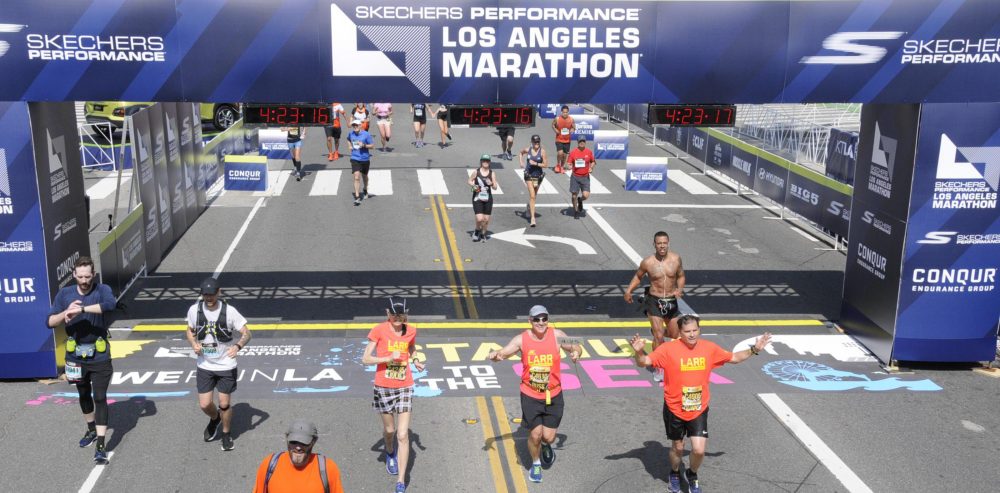
I get up a week later, on Marathon Sunday, eat breakfast, then struggle onto my bike to go cheer runners on at our club water station. My left leg has forgotten how to work the pedal so I ride with one hand on my knee to push it down. I meet up with several runners who trained with me after the race and listen to their stories. They inspire me and take me out of my funk.
That week, I will suffer the punishment for continuing my run when I should have stopped: extensive pain on the left hip and upper IT band, and a pinched nerve that wakes me in agony at the level of 7-8 on a 10 scale nearly every night for the next three weeks. Multiple hot showers at 1:00 AM, 3:00 AM, 4:00 AM are the only cure for screaming nerves. My sleep suffers; my work suffers. I spend the next several appointments with my PT fixing those problems instead of dealing with my quad.
Fast-forward six weeks:
The screaming pain from the IT band, back and hip muscles has largely disappeared, thanks to muscle relaxants, more Ibuprofen and Tylenol than was healthy, and time. I can run/walk between two and six miles depending on the intensity, and according to my physical therapist, my left quad is at 67% of the strength as my right one. A tremendous improvement given that six weeks earlier I couldn’t even do the test.
Prognosis: I expect to be able to complete the Mountains 2 Beach Half Marathon in early June comfortably, provided that I don’t race it. I can expect to begin full training by the middle of July. The earliest I can hope to “race” a half marathon is the Santa Rosa half in late August. I am running the New York City marathon and the California International Marathon four weeks apart, in November and December. The goal for one of them is to race it as hard as I can for a Boston Marathon qualifying goal, but this will depend on how my body responds to training, which marathon I choose to race, and how well I have learned the two lessons below:
LESSON ONE: I can’t just “run” and expect to maintain the strength I need to meet my goals. The quad issue didn’t just happen. For weeks, I had been feeling a soreness in my hamstring that I foolishly thought was just hamstring tightness. In reality, it was working harder than normal to take up some of the slack from a quadriceps that was growing steadily weaker over time.
There are specific running exercises that strengthen the muscles and tendons most used for running, and I must do them regularly, and I must have an executable plan to do them regularly. And I must, must, must hit the gym. Follow along for a peek over my shoulder for the strength training that will now be a big part of my life.
LESSON TWO: I should have turned around immediately when I knew I was injured. The pinched nerve in my back, the left hip muscle tear and the IT band injury were the direct result of continuing to run for over an hour after I should have stopped. Without getting too deep into my psyche and history, the reasons I did not immediately take the best care of myself at that moment run deep. This is going to require a coach of a different kind. Not turning around was a symptom, not the result of social pressure or a desire to prove to others that I could run through pain.
 Quest To Qualify