Ok, so the Macbeth quote isn’t the _best_ way to make my point, but I’m behind in this blog, there is a lot coming up to tell you about, and if I don’t write this now, with 20 minutes before I have to head into work, it’ll never get done and I may as well shut this whole enterprise down. Caveat Lector.
Long story short: my plan to train to run the LA Marathon at 8:45 per mile pace so that I could comfortably lead the pace at 10:00 per mile was a major success. As you recall from the previous post, I’m a pace leader for the LA Roadrunners. Along with four other “PL’s,” as we’re called, I worked with and trained around 20 or so runners to complete the marathon in 4:22:00. My organization, consisting of around a hundred or so PL’s, a thousand athletes, and six months of early Saturday mornings, is the official training program for the marathon. You may think that getting up ninety minutes earlier on a Saturday morning than on a weekday to lead our athletes on long runs in the rain, wind and cold would be a hardship, but it’s not. It’s an absolute joy.
But there is a bit of pressure. You have to be in shape enough to help your athletes through the tough parts of the course, usually starting around mile 16 or so (where you enter Beverly Hills, oddly enough. I call that section “The Valley of the Shadow of Death,” which will factor into this post in a little bit). If you are struggling yourself, you aren’t in a position to help your athletes when they need it most, let alone hold pace. Trust me; I know from experience. I struggled my first two years alongside my fellow runners, and while I was able to provide support, it was difficult for me. Both years, I struggled at about the 22 mile mark, right about when the course drops you downhill to the finish line. I was still able to help people out, but I felt like I could have done more. The problem was, most likely, that I was using the LA Marathon as a training run for marathons further down the road. Looking “beyond the mark,” in a manner of speaking.
I decided to make a change. I still have two or perhaps three marathons this year, one of which will be my Boston Qualifier attempt. But this year, instead of thinking about them, I focused only on LA. I trained this year to run the LA Marathon at 8:45 per mile.
Which meant that all my tempo runs were run at 7:45-8:00 pace, and that my easier runs during the week were run closer to 9:00 pace instead of my “I can run forever” pace of 9:40.
And…. I added more mileage.
Oddly enough, the image I had in my mind of feeling good and giving my athletes my full attention at mile 20 when they needed it wasn’t my motivational image.
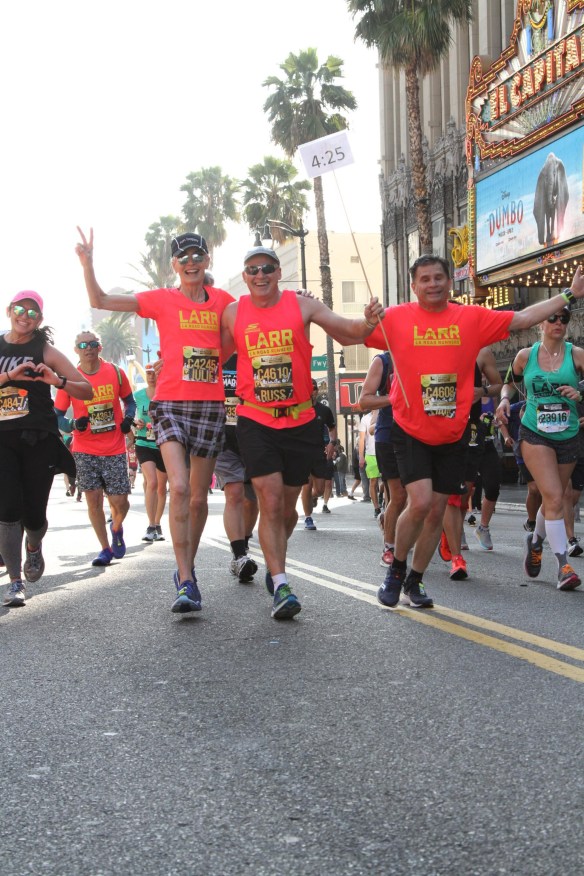
It was Beverly Hills. The Valley of the Shadow of Death.
It’s mile 16 of the marathon. All the roller coaster climbing out of downtown LA is done. Gentle rolling hills through Echo Park and into Hollywood, then at about the half way point, two major downhills into West Hollywood and a lateral over to Burton Way which takes you into 90210 town. The roadbed is exposed, and it’s getting hot. The race is now Serious, capital S. There’s an uphill, the angle of which fully exposes the back of your body to the glaring sun. It’s tough.
That’s what motivated me when I felt like I could skip a workout. That’s what got my butt out the door, even in the rain.
I felt a great deal of trepidation going into the race on Sunday. I’ve run LA seven times by now, and I knew where all the problems were. I hoped all my hard work would be enough. I prayed it would be. I worried I had done too much and that I was fatigued.
I needn’t have worried. Beverly Hills was a breeze. I’m sure the cooler weather helped a bit, but I felt strong. The dreaded nausea, cramps, weakness, whatever I was expecting, never appeared. We passed the Mormon Temple in Westwood and rounded the corner onto Sepulveda Blvd at mile 20. Feeling a little weak by this point, but other than that, fine.
A runner caught my attention. He asked me to talk to him, talk him through the wall that he was hitting. I don’t remember what I told him, but I know it helped. We ran for another half mile before he fell back to, hopefully, run a bit slower and not slow to a walk.
A second runner caught my attention at mile 23, right before the big downhill to the finish. He just asked me to talk to him, to say anything to distract him from what he was going through. I told him about a little mental game I play when I get tired in a race. I pretend that the race is over and now I’m just looking for my car. It got a bit of a smile from him, but I could tell he was really feeling it. He ducked behind me to get to a water stop and I lost him in the crowd. I sped up a bit to catch up with my fellow PL teammates, Russ and Julie, who were about a hundred yards ahead. I kept my eye out for anyone else from the LA Roadrunners (or anyone, actually) who I could be of assistance to. But by that point, at mile 24-25, there is very little chatter, just silence and dogged determination. “Let’s get this thing done!”
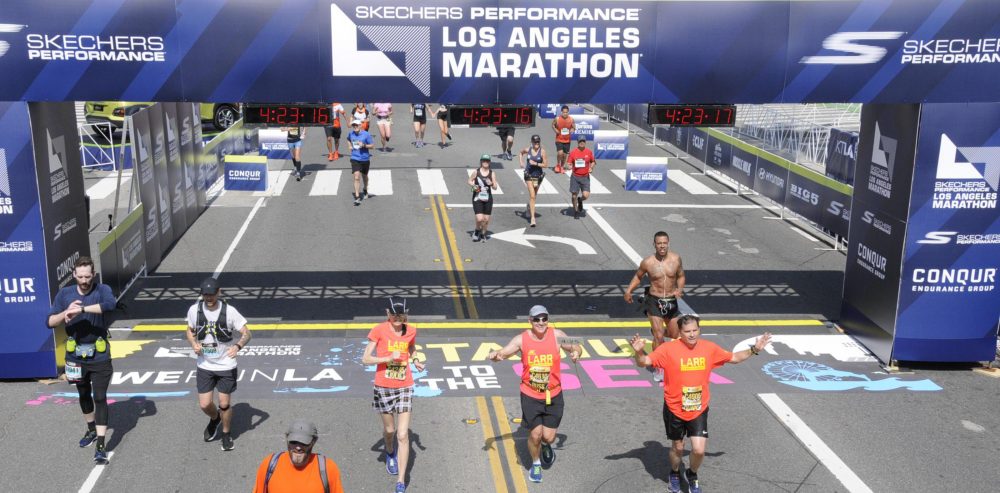
I crossed the finish line with Russ and Julie, thinking to myself that I could even run a bit further if I wanted to, but my legs took that opportunity to turn to concrete, and I settled for the zombie walk to the LA Roadrunners recovery tent to enjoy some snacks and commiserate with my fellow athletes, trade war stories and congratulate those who finished, especially those who just completed their very first marathon, not thinking or believing for a second six months earlier that they could even toe the start line and accomplish a major life goal.
Because that’s what the marathon is about.
And now, time to look ahead…!

 Quest To Qualify