My Latest VDOT Test

Back in September, I signed up for the virtual Santa Monica Classic 5k. A week later, I received a nifty little box in the mail consisting of a runners buff, fuel samples, a T shirt and last but not least, a finishers medal.

Many things conspired against me actually “racing” this event, virtually or not: I wanted to train for it for a fast PR. I’m already running a great deal throughout the week, I don’t have the time to drive to the one place where I can be guaranteed a fast course, and even if I did, I have plenty of time before the December 31st deadline.

On Christmas Day, I realized that I had almost run out of excuses. And since I had no plans to travel anywhere to get infected with “The Cov,” there was nothing stopping me from earning that finishers medal except laziness.

At 2:00 PM, when foot and bike traffic on the Santa Monica bike path was as full as you would expect at mid afternoon on a major holiday, I took a deep breath, expelled it, and launched myself south down the bike path. Dodging walkers, cyclists, automobiles and even other runners, I made my way along at a semi uncomfortable 7:30/mile pace. Within a half mile, I knew that would be my pace, no matter how much I wanted it to be faster.

But this was a VDOT test, after all! I rationalized. This tells me where I’m at:

Average for each mile was: 7:30, 7:40, then 7:30 again. With a tenth of a mile to go (that pesky 0.1!) I pushed myself to the limit, averaging 6:45 for that little stretch.

So where am I? Exactly where I was this time last year, and 45 seconds slower (overall) than I was five years ago.

I’ve done a lot of things right, but if I want to do more than merely “hold place” as the years tick along, I’m going to have to train smarter.

That’s what the new year is for. How will this next revolution around the Sun go? Stick around and find out.

The Runs of Summer

After a long delay filled with nothing at all but endeavoring to train consistently and dealing with real life, here are a few photos of some of the runs I wrote about in my previous post. And yes, I will be posting more frequently now that some non-running related stresses have been removed, and that there appears to be a bit of light at the end of the tunnel to this whole Covid thing.

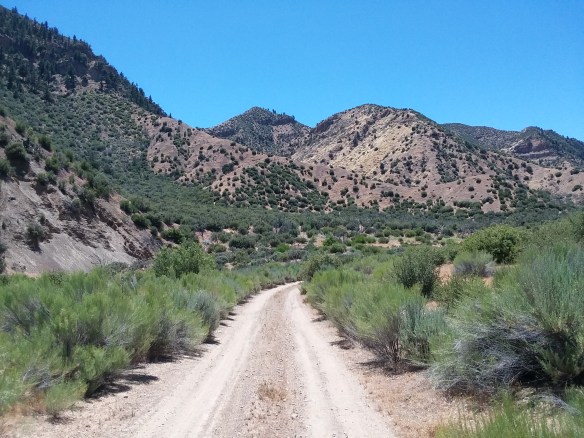
Dry Canyon Road

About an hour north of Ojai along Highway 33 is a lone stretch of landscape called Rancho Nuevo in the Los Padres National Forest. The road runs about 20 miles north up into a land of scrub pine and year round springs, then down into appropriately named Dry Canyon.

This area is, by far, THE most remote feeling location I’ve ever run in. Not even runs in bona fide wilderness areas feel as remote as this run, which is why I return to it as often as I can.

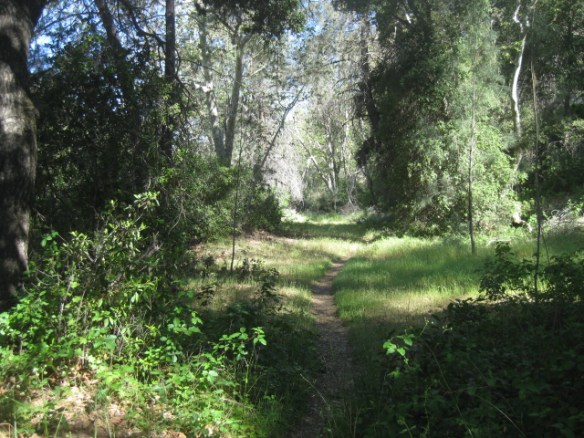
Manzana Trail
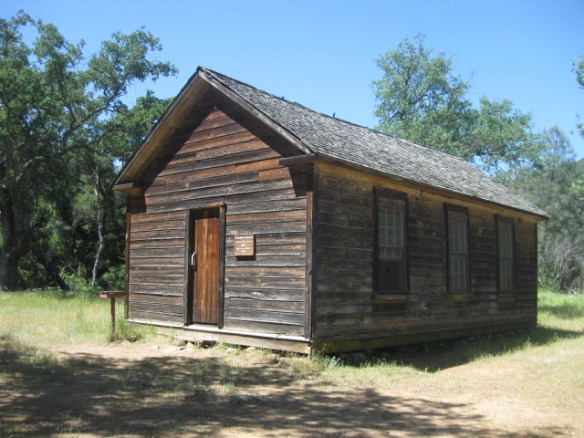
Manzana is Spanish for Little Apple. Apropos since this 8.5 mile trail takes you to a turn of the (previous) century school house, long since abandoned.
Manzana School house
Manzana School House

This bucolic scene is called the San Rafael Wilderness, about an hour north west of Santa Barbara. To get to this particular trailhead, you have to navigate a paved road where the word “paved” means that careless driving can remove an axle, particularly from a twenty year old low-slung Honda Civic.

The trail itself is called the Manzana Trail, and it leads about 8.5 miles from the start near Nira Campground to a turn of the (previous) century one room school house where homesteaders attempted to settle and tame the land. It didn’t work, but the upside is it’s an amazing place to spend three hours running through streams without slipping, and dodging resident horses who claim the space where a working ranch still exists by ambling up to you out of nowhere and neighing a horsy “hello.”

Whitney Trail
Did you know there is a trail that runs up to the actual Whitney Portal? There is, and I ran it.

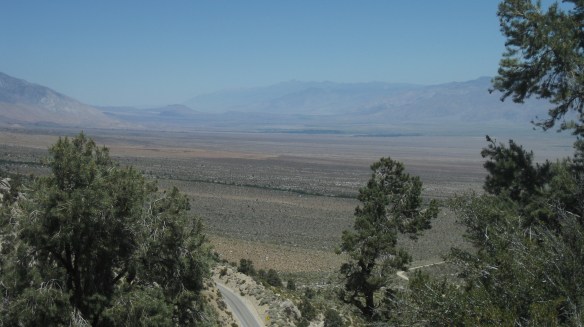
This beautiful photo of the southern Owens Valley was taken half way up three miles of living hell. You can see a portion of the Lower Whitney Portal trail on the lower right, which from that point ascends a lung busting 20% grade up to my current vantage point, a mere two and a half miles from the start, with about another mile and a half to go. The entire route ascends nearly four thousand feet in elevation over four miles. But it takes you up to Whitney Portal where they serve an awesome turkey burger. Which is perfect mid level ballast for the harrowing descent back down.

Thousand Island Lake
The Sierra Nevadas, as envisioned by Satan.
Alien Sun
Alien Sun

Through the burning hell of a forest fire I ascended. My reservation at Reds Meadow Resort and rental car too expensive to waste sitting around stewing in ash and getting angrier and more frustrated by the second, I put my lungs to the test and ascended the nine mile segment of the Pacific Crest Trail north of the Devils Post Pile National Monument up to an intersection with the John Muir Trail at Thousand Island lake. Oddly enough, the smoke seemed to dissipate once I passed 10,000 feet elevation, but that may have been the hypoxia speaking.

But seriously. The weather was clear as a bell all the way up I-395 until just south of Mammoth Lakes, when a bank of storm clouds I assumed was some sort of late season thunderstorm resolved into an ash cloud generated by the fires near Fresno and the western entrance into Yosemite National Park. I knew there was a health risk when I took off for this six hour excursion, and I should have made other plans. But I survived, and the lingering cough I caught from it dissipated after a few days. After the fact, I find myself googling terms like “lung cancer risk” and PM2.5 hazards. What’s done is done, but…

Eighteen round trip miles of Sierra awesomeness with 3,000 feet of elevation gain, but at what cost? WHAT COST?

The runs will continue. Moving through wilderness at person speed is essential to maintaining my love of running so that I can reach the goals I’ve set for myself, and most importantly, surpassing them. Because if not now, when?

See you next.

Quick Addendum: Staying out of that “grey zone”

One thing I need watch out for, and how:

The Grey Zone.

Run your easy runs slow, and your other runs fast, goes the mantra.

So why, on my eight mile supposedly easy run yesterday, did I jump in pace from 9:45 (my designated easy pace) to 8:30 and a touch faster for the last three miles? Chased by adoring fans (whoever you are) or a knife wielding dervish looking to bring on the Apocalypse?

Nope, just:

Having a good time (like most people, running is stress relief)

An unexpected burst of energy from improved fitness (see previous post for my base training successes)

Wanting to see where I’m “at” right now.

What did I get in return? Other than the warm glow of satisfaction, I walked around today with sore knees. May have had something to do with the brand new Saucony’s, the soles of which are hard as a board when they are brand new, maybe not. All I know is, a 45 minute marathon race pace run that was supposed to happen today didn’t because I didn’t want to risk further injury. The knees are feeling better now, but I’m going to have to run five EASY miles tomorrow on my designated recovery day, followed by my scheduled 18 miles on Saturday. I’ll do it, but I’d have preferred to rest tomorrow instead of today.

Lesson learned: follow the schedule. The running brain on paper. Save the long surges for when I need them!

End communication.


Everything I learned during my base building phase in one word

Consistency.

Long story short, I followed the plan I posted above (well, 85% of it, anyway), including hills, long runs, speed work, and a bit of time off to let the body and mind rest.

Then I put myself through a two week build phase for my VDOT test, the Santa Monica Classic 5k. Ran the Santa Monica Classic 5k, which is a point to point course with approximately two miles of gentle uphill. Finished in 23:25, good enough for 5th place in my age group, and 101st place overall out of 1,500 or so runners. Not sure why I’m throwing those stats in there; most likely a salve to my ego that four years ago I ran the exact same race with the exact same course about 40 seconds faster. But it was a good enough result to tell me that my base building had not been in vain, and that with proper training I can gain all that speed back, and then some.

VDOT: 41. Does that number sound familiar? It should, because it’s the exact same VDOT I started this blog with. But that’s okay (I tell myself, reminding myself to breathe). Positive changes take a bit of time to percolate through the system. And in the meantime, here is what I gained through the base building phase, and where I am now a month into my quality training phase with 10 weeks to go until the California International Marathon in Sacramento on December 8, 2019:

Consistency. Yep, that word again. Consistently following a training plan for a period of time is more valuable than a series of sporadic fits and starts, even if those little run bursts are impressive in their own right. I have a schedule, drawn up by David Levine (of The Idiot’s Guide to Marathon Running fame). That schedule is my running brain. I run what it says, with very little, if any, variation. A VDOT of 41 equates to roughly an 8:30-8:45 marathon pace, which would cut in half the distance between my PR at Mountains 2 Beach and 3:30, my BQ PR minus five full minutes. Consistency in training at a pace congruent to my current ability is 90% of what I need to do to hit my goal.

Flexibility. Fell off the wagon a bit here. Was doing specific stretching for several weeks in a row when when most those niggling running pains disappeared into memory. Slacked off a bit, and wouldn’t you know it? They came roaring back like a bad habit.

Excess weight: I have ten pounds I can easily lose without trying, without doing more than making a few minor adjustments over the next two months. I’m 5’8″, a bit “thick” (i.e., not whipcord thin), and carry a little bit around the waist I don’t need. No gut to speak of, but I feel it around my torso like a weight belt. I can lose it, easy. Dropping from 180 to 170 pounds will give me more energy and running strength in those last few miles than I can imagine right now.

My “why.” That’s the biggest gain. I know exactly why I want to do this. I know I have it in me to run at least 3:30 in the marathon, which is a five minute cushion of my actual 3:35 Boston qualifying time. I know of too many people who have reached similar goals and crashed through them to think of myself as the lone guy who somehow, for genetic or other reasons, couldn’t pull it off. My ego isn’t that big. All I need to do is put in the work: lots of long, slow mileage to build fitness at the cellular level and increase stamina, most of it during the week on short (4-6 miles) and medium length (7-10) runs, with a long run every weekend. Tempo runs at 30 seconds per mile faster than marathon race pace. Some repetitions to increase turnover. The right foods. Flexibility and rest. And sleep, blessed sleep. Nine hours of it each and every night.

I’m a month into quality training now. Starting Monday, October 7th, I’m going to post my weekly workout, and follow up on how it felt, and how well I did. Flexibility, diet, weight management, it’s all going to be in there. I’ll try to keep it entertaining, but I’m not going to pretend that this blog is going to make history, or even inspire someone who reads it to push through their own personal walls. I’m writing this blog to hold myself accountable. To prove to myself that I can do it. Because I can.

So there.

Golden State Highway

Let’s face it: the only way to get better at running hills is to, well, get off your lazy butt and run them. Hill training is a part of marathon life, and if you’re not willing to put yourself through it, why are you running, anyway?

After all, hill training offers the following benefits:

  • Improved running mechanics
  • Speed
  • Strength
  • Endurance
  • Confidence

I may be wrong. Perhaps not everyone needs to run hills to race. But if, like me, you are gunning for a Boston Marathon qualifying time, you’d better put hill running on your calendar or you will end up missing some terrific benefits.

My problem: I get bored easily when I run the same routes. Solution? Find new ones. I’ve compiled a list.

First on the list: after spending the night up at the Mt. Pinos dark sky site to rebel against the “fall back” time change and break in a new pair of binoculars, this place.

Old Hwy 99

Old Highway 99, abandoned and unmaintained, once called the Golden State Hwy, but known today as the Templin Hwy.

If you’ve ever driven up Interstate 5 on your way to anywhere north of Santa Clarita, you’ve probably passed by a stretch of California highway history without even realizing it.

The Golden State Highway. Ol’ Route 99. And much like that stretch of US 66 near Flagstaff immortalized in the original Cars movie, largely forgotten. It was the path out of Los Angeles to points north, until the Department of Water and Power decided to create Pyramid Lake and the Johnson administration finished the last of the paving on the newly christened Golden State Freeway.

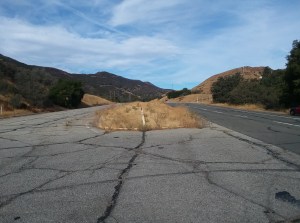
But the stretch I ran today still exists. From where I parked after exiting the I-5 at the Templin Highway exit, the road ascends a perfectly engineered 5% grade for two miles before dropping three miles to a gate accessible to the Department of Water and Power that leads to the dam holding back all that water at Pyramid Lake. The gate is open to hikers and cyclists; in fact, Piru Creek, which carries the lake’s overflow, is one of those hidden fishing spots no one wants to tell outsiders about, judging from the few vehicles parked at the gate and the dearth of campers, despite the available facilities. Taken as a whole, it is a monumental fourteen mile hill run, undulating five hundred feet up its first two miles, then down close to seven hundred feet over the next three miles to the DWP gate, and finally up again through the gate to the point where a DWP access-only sign warns you against proceeding any further.

A fourteen mile round-trip sun-exposed hell-beast of a hill run, a mosaic of broken pavement that time forgot. A pitted nightmare for cars (you will slow down or you’ll find yourself airborne sans an axle at one particularly troublesome spot). And the Highway Patrol loves it because after pulling you over on the Interstate, they can drive it back up to a secret gate that opens to their speed trap hidey-hole at a brake check pull out.

At some point, I will have to conquer the entire thing, but not today. On tap was an easy four miler consisting of two miles up and two miles down. A gusting headwind made the 5% grade particularly troublesome, and my upward run turned into a series of four half mile long hill repeats. But not to worry, I will run the entire 14 mile route. Because if I can’t, there is no way I can qualify to run Boston.

More to come.

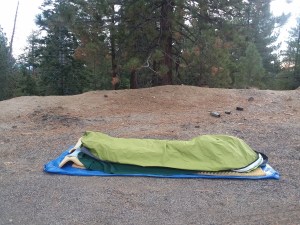
Pinos Camp

This is how I ignore the whole “Spring Forward / Fall Back” issue.

The Bible

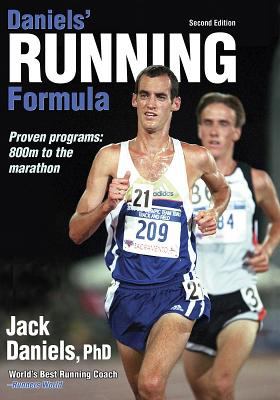
Daniels' Running Formula Book

Since I started running seriously in 2010, I’ve bought and read a dozen books on running. Of those twelve, I’ve gifted, given away, or otherwise tossed eleven of them. This is the book that remains. Because it shows me, based on data acquired through the author’s experience using the scientific method, exactly where I succeed and where I fail.

Not that the other books were all bad. Most offered much needed advice, motivation and methods for training and running races from the 5k to the marathon. The authors of those books told me that I could accomplish things, and even demonstrated how to do so. What they couldn’t tell me was why.

Why is the vast majority of my training running long and slow? Why does running this pace for my tempo runs benefit me and that pace doesn’t? Repetitions, Intervals, and Tempo Runs? And most importantly why am I not getting faster?

Because, the book explained to me (in a manner of speaking), you are not yet able to train for a faster marathon pace than you are capable of running right now.

That was a tough pill to swallow. We all had coaches, teachers and parents attempt to motivate us at whatever we were struggling with by saying “just get better!”. It worked just well enough to perpetuate the myth that you can convince yourself that you can do anything, as long as you believe you can do it.

But the fact is that when you set a goal to improve on something, whether it be a sport like running or any worthwhile endeavor, you have to start where you are.

And Daniels’ Running Formula does what few books can: it tells me how fast a runner I am… right now.

You see the term VDOT all over the running literature these days. Thank Jack Daniels for that. It was his years of research and testing a broad spectrum of runners that brought the term into the running consciousness. In broad strokes, the VDOT is the amount of oxygen an athlete uses while running. Within a bit of variability due to running economy (which can be improved with practice), it puts a number on your current fitness to run a race. The higher the number, the faster you can run, as long as you put in the right kind of training.

Your VDOT is easy to calculate: run a specific distance as best you can (anywhere from 1 mile to a marathon, though in my experience a 10k or half marathon appears to be most accurate), and look up your time in a VDOT table available in Daniels’ book or any one of several hundred sites online. That’s your number. That’s your anchor. That’s where you start. There are training paces for various workouts associated with that number. Set your training plan and get to work.

When this fact finally dawned on me, I almost wept. Not because I had discovered the Holy Grail, but because all those “you can do anything you set your mind to” myths howled out of me in agony. How do I get faster in the future if I train for the pace I’m capable of running now? Why can’t I just train at the paces associated with the speed I aspire to?

Sure! Why not? Another part of me replied. And I can get sick, injured, irritable, lose sleep, get hurt, and defeat the entire purpose of training in the first place. Set to! Enjoy!

If training depended entirely on pace, the impatient part of my brain would be right on. But it’s not just pace that gets you to your goal; it’s consistency. I know runners who have knocked an hour off their marathon times within the few years that I have known them. Why? Because they learned the lesson I am finally learning now. Start where you are. Run the paces that strengthen the ability you currently have, and train consistently.

In the next post, I will talk about the race I ran last weekend that gave me my current VDOT. If I follow my own advice, start where I am, and train consistently, I will find that, in spite of my self doubt, I will have become a faster runner. My next race will prove it.

I’m on my way. As are we all.

So: Where am I?