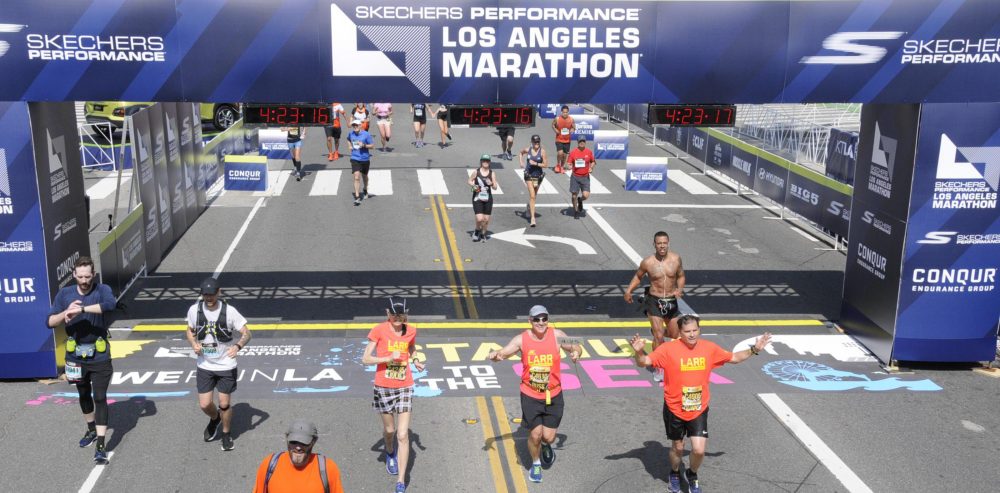
“Out, damned spot!” Exorcising ghosts of marathons past at the Los Angeles Marathon

Ok, so the Macbeth quote isn’t the _best_ way to make my point, but I’m behind in this blog, there is a lot coming up to tell you about, and if I don’t write this now, with 20 minutes before I have to head into work, it’ll never get done and I may as well shut this whole enterprise down. Caveat Lector.

Long story short: my plan to train to run the LA Marathon at 8:45 per mile pace so that I could comfortably lead the pace at 10:00 per mile was a major success. As you recall from the previous post, I’m a pace leader for the LA Roadrunners. Along with four other “PL’s,” as we’re called, I worked with and trained around 20 or so runners to complete the marathon in 4:22:00. My organization, consisting of around a hundred or so PL’s, a thousand athletes, and six months of early Saturday mornings, is the official training program for the marathon. You may think that getting up ninety minutes earlier on a Saturday morning than on a weekday to lead our athletes on long runs in the rain, wind and cold would be a hardship, but it’s not. It’s an absolute joy.

But there is a bit of pressure. You have to be in shape enough to help your athletes through the tough parts of the course, usually starting around mile 16 or so (where you enter Beverly Hills, oddly enough. I call that section “The Valley of the Shadow of Death,” which will factor into this post in a little bit). If you are struggling yourself, you aren’t in a position to help your athletes when they need it most, let alone hold pace. Trust me; I know from experience. I struggled my first two years alongside my fellow runners, and while I was able to provide support, it was difficult for me. Both years, I struggled at about the 22 mile mark, right about when the course drops you downhill to the finish line. I was still able to help people out, but I felt like I could have done more. The problem was, most likely, that I was using the LA Marathon as a training run for marathons further down the road. Looking “beyond the mark,” in a manner of speaking.

I decided to make a change. I still have two or perhaps three marathons this year, one of which will be my Boston Qualifier attempt. But this year, instead of thinking about them, I focused only on LA. I trained this year to run the LA Marathon at 8:45 per mile.

Which meant that all my tempo runs were run at 7:45-8:00 pace, and that my easier runs during the week were run closer to 9:00 pace instead of my “I can run forever” pace of 9:40.

And…. I added more mileage.

Oddly enough, the image I had in my mind of feeling good and giving my athletes my full attention at mile 20 when they needed it wasn’t my motivational image.
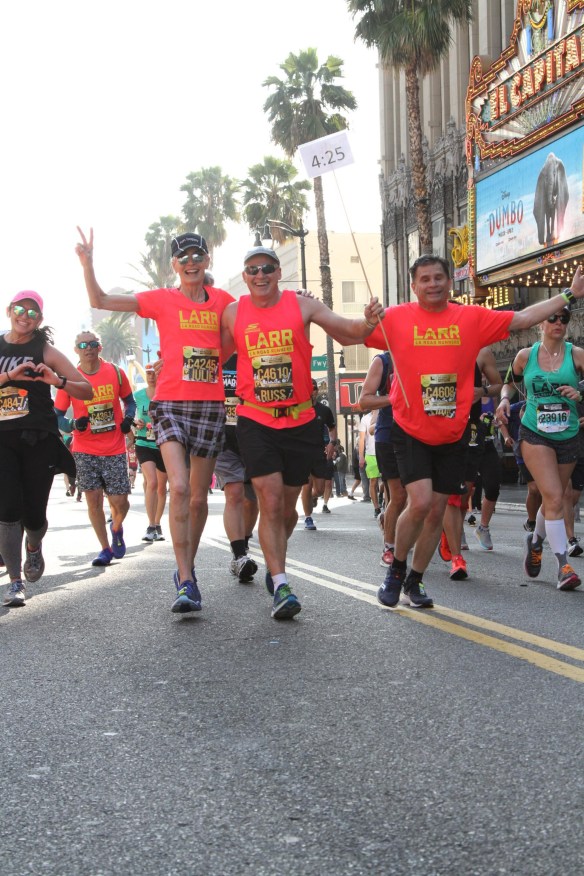
It was Beverly Hills. The Valley of the Shadow of Death.

It’s mile 16 of the marathon. All the roller coaster climbing out of downtown LA is done. Gentle rolling hills through Echo Park and into Hollywood, then at about the half way point, two major downhills into West Hollywood and a lateral over to Burton Way which takes you into 90210 town. The roadbed is exposed, and it’s getting hot. The race is now Serious, capital S. There’s an uphill, the angle of which fully exposes the back of your body to the glaring sun. It’s tough.

That’s what motivated me when I felt like I could skip a workout. That’s what got my butt out the door, even in the rain.

I felt a great deal of trepidation going into the race on Sunday. I’ve run LA seven times by now, and I knew where all the problems were. I hoped all my hard work would be enough. I prayed it would be. I worried I had done too much and that I was fatigued.

I needn’t have worried. Beverly Hills was a breeze. I’m sure the cooler weather helped a bit, but I felt strong. The dreaded nausea, cramps, weakness, whatever I was expecting, never appeared. We passed the Mormon Temple in Westwood and rounded the corner onto Sepulveda Blvd at mile 20. Feeling a little weak by this point, but other than that, fine.

A runner caught my attention. He asked me to talk to him, talk him through the wall that he was hitting. I don’t remember what I told him, but I know it helped. We ran for another half mile before he fell back to, hopefully, run a bit slower and not slow to a walk.

A second runner caught my attention at mile 23, right before the big downhill to the finish. He just asked me to talk to him, to say anything to distract him from what he was going through. I told him about a little mental game I play when I get tired in a race. I pretend that the race is over and now I’m just looking for my car. It got a bit of a smile from him, but I could tell he was really feeling it. He ducked behind me to get to a water stop and I lost him in the crowd. I sped up a bit to catch up with my fellow PL teammates, Russ and Julie, who were about a hundred yards ahead. I kept my eye out for anyone else from the LA Roadrunners (or anyone, actually) who I could be of assistance to. But by that point, at mile 24-25, there is very little chatter, just silence and dogged determination. “Let’s get this thing done!”
I crossed the finish line with Russ and Julie, thinking to myself that I could even run a bit further if I wanted to, but my legs took that opportunity to turn to concrete, and I settled for the zombie walk to the LA Roadrunners recovery tent to enjoy some snacks and commiserate with my fellow athletes, trade war stories and congratulate those who finished, especially those who just completed their very first marathon, not thinking or believing for a second six months earlier that they could even toe the start line and accomplish a major life goal.

Because that’s what the marathon is about.
And now, time to look ahead…!
Training When Life Gets Hard

Jobs. Family responsibilities. Car trouble. Time commitments made but then forgotten. Bad weather. Then even worse weather.

Lack of motivation, depression, anxiety, regret, loss, lack of sleep, overall lack of energy due to the constant grinding of life against one’s limited physical, mental, social and spiritual resources.

#Amirite?

Still gotta train, though!

It’s been several months since my last entry, and I apologize. But, you know, stuff.

So, where am I at? Right now, I’m in a pretty good place.

A little backstory:

I am a pace leader for the LA Roadrunners running club, the official training program for the LA Marathon. Which means that every Saturday morning from September through Marathon Day in March, rain or shine, I rise at oh-dark-thirty in the blessed ayem, a full ninety minutes earlier than I do for my day job, slam as much of a healthy breakfast as I can down my pie-hole, and drive to Marina Del Rey to meet several hundred runners who depend on me and about ninety other “PL’s” who have made the same commitment, and lead them on long training runs around Marina Del Rey and up into Santa Monica. Along the way, we provide coaching, encouragement, friendship and at times a bit of therapy as we make our way along sidewalks, beach paths and the occasional shoulderless stretch of roadway on our 10,12,14,16,18,and 20+ mile runs.

I pace a group corporately named “Run Group 6,” which means we run 11 minute miles on these long runs as part of training for a 10 minute per mile marathon pace. Which means that as the calendar falls headlong into the throat of winter, we spend a increasingly long amount of time in each others’ company. In the case of our longest run coming later next month, that time will be around three hours and forty minutes.

These runs are always done with the idea that suffering together creates a diverting, relaxed congenial atmosphere. Running as a social lubricant.

It also means that as pace leaders, we are expected to be  stronger runners than the runners we are leading. Can’t do that if you are suffering as much as the runners under your care.

Need a motivation to train? There you go!

Because when the actual race gets tough, as it always does around mile 18, we are the ones our fellow runners will look to for encouragement and motivation. And we need to be in a position to provide it.

Life got a bit rough for me during the holidays late last year, and it was tempting to let things slide and just sleep in on the weekday mornings, and surrender to MASH and Star Trek reruns in the evening after work. And a few times, laziness won out. But overall, knowing what will be expected of me at the LA Marathon pushed me out the door. And oddly enough, who’da thought, running can lift burdens and provide much needed perspective on non-running aspects of my existence.

Life evened out after the new year, and I surprised myself with the realization that I ran twenty miles more in January this year than January last. It was a major accomplishment.

But then, oddly enough, it began to rain in Los Angeles. A lot.

And right about that time, my car needed some much needed attention, requiring me to take “alternate transportation” to that all important day job.

The bike.

Not the motorized kind, mind you. The regular kind. The kind that you have to pedal in order to push through the rain.

So for several days, I donned all the rain gear I could find and biked through the sloppy wet streets in a downpour to the Expo line train station, rode the train as close to my work as I could, then pedaled the rest of the way there. A change into some dry socks and shoes, and I was good to face the workday. Then, at five pm, re-don the wet shoes and socks and lather, rinse, repeat to home.

Life happens, right?

Like when the derailleur on your back wheel gives out just as you decide to pedal your way through a six inch pool of standing water a hundred yards long, as the uncaring automobiles slide past you sending little tsunamis up and over your calves, your rain gear now useless because God chose that moment to give you a demonstration of what old man Noah must have gone through back in the day, and when you get home, you end up dragging half the puddle you pushed through all over and into the new carpeting your landlord installed as a justification for the rent increase.

And you’re going to towel off, don your running clothes, turn around and do a six mile hill workout after all that?

Hello Hawkeye, Trapper and Frank Burns. What are you up to this fine evening? I’m sorry, but I’m not that strong.

Besides, I will have to _walk_ to the train station tomorrow morning because the garage had to send out for a part that will take a full day to get to them so they can install it. Oh boy.

But take heart, friends. I’m going to pull this off. Here’s how:


According to my training log, I ran 180 miles from January 1st of this year to yesterday morning. Was shooting for around 220, but considering everything, I’ll take it.

With four weeks of training “build” and a two week taper before the marathon, I will be running my highest mileage weeks, and I feel strong, and mentally and physically ready to push through whatever training, and life, throws at me.

The greatest decision I made this training cycle was to NOT overlook the LA Marathon on the way to Mountains 2 Beach, my BQ race. Of course, I’m training for both, but I am approaching the LA Marathon as a separate race entirely: I am training _specifically_ to run the LA Marathon at 8:45 per mile pace, or in a 3:50 finish time.

Of course, as a pace leader for LARR Run 6, I won’t be running the marathon at that pace. I will lead my group to a 4:22 finish, running 10 minute miles. And by focusing specifically on the LA Marathon and training to run it at a full half hour faster, I will have the strength and perseverance to help as many runners as possible reach their goal of finishing the marathon in 4:22 or better.

Because life is challenging for everyone. And how do we find respite from our challenges? By challenging ourselves to accomplish something we once thought impossible, and having a little fun along the way.

Golden State Highway

Let’s face it: the only way to get better at running hills is to, well, get off your lazy butt and run them. Hill training is a part of marathon life, and if you’re not willing to put yourself through it, why are you running, anyway?

After all, hill training offers the following benefits:

  • Improved running mechanics
  • Speed
  • Strength
  • Endurance
  • Confidence

I may be wrong. Perhaps not everyone needs to run hills to race. But if, like me, you are gunning for a Boston Marathon qualifying time, you’d better put hill running on your calendar or you will end up missing some terrific benefits.

My problem: I get bored easily when I run the same routes. Solution? Find new ones. I’ve compiled a list.

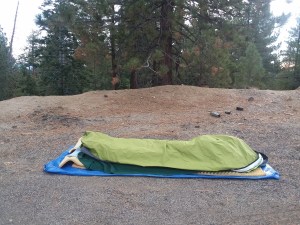
First on the list: after spending the night up at the Mt. Pinos dark sky site to rebel against the “fall back” time change and break in a new pair of binoculars, this place.

Old Hwy 99

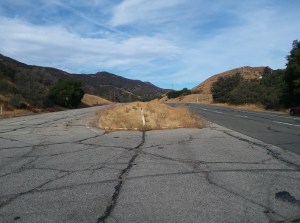
Old Highway 99, abandoned and unmaintained, once called the Golden State Hwy, but known today as the Templin Hwy.

If you’ve ever driven up Interstate 5 on your way to anywhere north of Santa Clarita, you’ve probably passed by a stretch of California highway history without even realizing it.

The Golden State Highway. Ol’ Route 99. And much like that stretch of US 66 near Flagstaff immortalized in the original Cars movie, largely forgotten. It was the path out of Los Angeles to points north, until the Department of Water and Power decided to create Pyramid Lake and the Johnson administration finished the last of the paving on the newly christened Golden State Freeway.

But the stretch I ran today still exists. From where I parked after exiting the I-5 at the Templin Highway exit, the road ascends a perfectly engineered 5% grade for two miles before dropping three miles to a gate accessible to the Department of Water and Power that leads to the dam holding back all that water at Pyramid Lake. The gate is open to hikers and cyclists; in fact, Piru Creek, which carries the lake’s overflow, is one of those hidden fishing spots no one wants to tell outsiders about, judging from the few vehicles parked at the gate and the dearth of campers, despite the available facilities. Taken as a whole, it is a monumental fourteen mile hill run, undulating five hundred feet up its first two miles, then down close to seven hundred feet over the next three miles to the DWP gate, and finally up again through the gate to the point where a DWP access-only sign warns you against proceeding any further.

A fourteen mile round-trip sun-exposed hell-beast of a hill run, a mosaic of broken pavement that time forgot. A pitted nightmare for cars (you will slow down or you’ll find yourself airborne sans an axle at one particularly troublesome spot). And the Highway Patrol loves it because after pulling you over on the Interstate, they can drive it back up to a secret gate that opens to their speed trap hidey-hole at a brake check pull out.

At some point, I will have to conquer the entire thing, but not today. On tap was an easy four miler consisting of two miles up and two miles down. A gusting headwind made the 5% grade particularly troublesome, and my upward run turned into a series of four half mile long hill repeats. But not to worry, I will run the entire 14 mile route. Because if I can’t, there is no way I can qualify to run Boston.

More to come.

Pinos Camp

This is how I ignore the whole “Spring Forward / Fall Back” issue.

The Starting Line

VDOT 41

There it is.

“A journey of a thousand miles begins with the first step.” And I’ll be covering about that much ground between now and Memorial Day weekend, if not more.

Which, according to Jack Daniels, means this:

I am fit enough, right now, to train for a marathon pace of 8:35 per mile. This translates roughly to a marathon time of three hours and forty five minutes.

Even if, after consistent training, my VDOT doesn’t budge, I still PR in the marathon by almost a half hour. Nothing to take for granted, believe me. But I have seen too much evidence that the VDOT needle won’t move anywhere but up.

As long as I do the work.

Ventura Half Marathon 2018

Ventura Half 2018

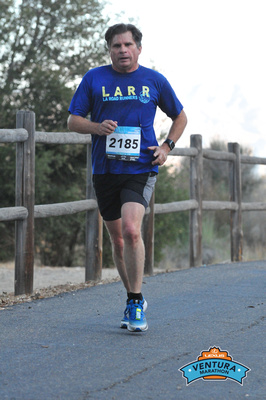
Ventura Half Marathon 10-21-18

So, the Ventura Half Marathon, October 21, 2018.

I originally signed up for the full marathon shortly after running Mountains 2 Beach on Memorial Day, but I didn’t realize at the time how much I simply wanted to run for fun this last summer instead of training for yet another race (more on taking a mental break in a future post). Switching to the half marathon was an easy decision, and as a bonus it provided valuable insight into my current marathon fitness.

By the way, choosing to spend the night before the race at a motel in Ventura instead of arising at zero dark thirty and making the seventy mile schlep is one of the Great Decisions that have made my life worth living. It is right up there with contributing weekly to my 401k and not saying anything to offend my mother. There is a world of difference between getting up at 5:00 AM, which a reasonable person understands is morning (albeit a tad early) and an hour and a half earlier, which is quiet enough to make you wonder if civilization exists at all.

At five in the morning, I can find my way to the shuttle bus, talk about race strategy with anyone who will listen, and do a bit of warm up before the starting gun goes off. At three thirty, I can’t find my pants. A hundred and twenty dollars well spent. Trust me on this one.

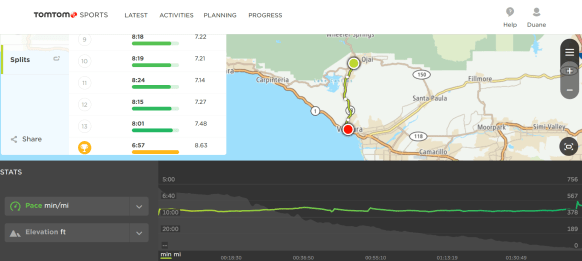
The Ventura Half is almost all downhill (though the 600 foot drop is not, to abuse a brand name, Revel-ly). Oddly enough, that worked against me for the first few miles, as I wasn’t properly warmed up until I was about three miles in. But running down the Ojai bike path through the arboreal paradise of the Ojai valley is its own reward, and crossing the wooden San Antonio Creek bridge is, if I may say, a delight.

Of course, all good things come to an end at some point. The path flattens out and enters an oil soaked industrial wasteland, a reminder that the good ol’ USA doesn’t yet value alternative energy as much as other civilized countries do. Even then, the path winds its way through all that in a manner that makes you want to spread your arms out and yell “wheeee!” as you make every bend in the road. And all too soon, the bike path ends, and you turn a few corners and jump a few curbs as you enter Ventura proper and cross the finish line at Mission Park just a few blocks away from where I spent the night in not-getting-up-at-3:30 peace.

1:48:07. Not bad. Not my best, especially since I hadn’t run more than twice a week for the previous month, but it shows me where my marathon fitness is right now. I have a lot of road between today and a Boston Qualifier at the Mountains 2 Beach marathon next Memorial Day weekend.

But I know exactly where to start.

The Bible

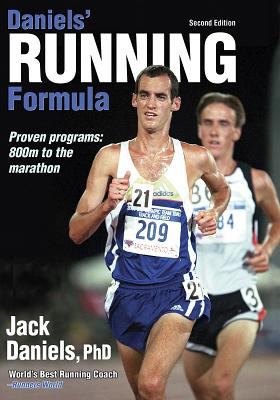
Daniels' Running Formula Book

Since I started running seriously in 2010, I’ve bought and read a dozen books on running. Of those twelve, I’ve gifted, given away, or otherwise tossed eleven of them. This is the book that remains. Because it shows me, based on data acquired through the author’s experience using the scientific method, exactly where I succeed and where I fail.

Not that the other books were all bad. Most offered much needed advice, motivation and methods for training and running races from the 5k to the marathon. The authors of those books told me that I could accomplish things, and even demonstrated how to do so. What they couldn’t tell me was why.

Why is the vast majority of my training running long and slow? Why does running this pace for my tempo runs benefit me and that pace doesn’t? Repetitions, Intervals, and Tempo Runs? And most importantly why am I not getting faster?

Because, the book explained to me (in a manner of speaking), you are not yet able to train for a faster marathon pace than you are capable of running right now.

That was a tough pill to swallow. We all had coaches, teachers and parents attempt to motivate us at whatever we were struggling with by saying “just get better!”. It worked just well enough to perpetuate the myth that you can convince yourself that you can do anything, as long as you believe you can do it.

But the fact is that when you set a goal to improve on something, whether it be a sport like running or any worthwhile endeavor, you have to start where you are.

And Daniels’ Running Formula does what few books can: it tells me how fast a runner I am… right now.

You see the term VDOT all over the running literature these days. Thank Jack Daniels for that. It was his years of research and testing a broad spectrum of runners that brought the term into the running consciousness. In broad strokes, the VDOT is the amount of oxygen an athlete uses while running. Within a bit of variability due to running economy (which can be improved with practice), it puts a number on your current fitness to run a race. The higher the number, the faster you can run, as long as you put in the right kind of training.

Your VDOT is easy to calculate: run a specific distance as best you can (anywhere from 1 mile to a marathon, though in my experience a 10k or half marathon appears to be most accurate), and look up your time in a VDOT table available in Daniels’ book or any one of several hundred sites online. That’s your number. That’s your anchor. That’s where you start. There are training paces for various workouts associated with that number. Set your training plan and get to work.

When this fact finally dawned on me, I almost wept. Not because I had discovered the Holy Grail, but because all those “you can do anything you set your mind to” myths howled out of me in agony. How do I get faster in the future if I train for the pace I’m capable of running now? Why can’t I just train at the paces associated with the speed I aspire to?

Sure! Why not? Another part of me replied. And I can get sick, injured, irritable, lose sleep, get hurt, and defeat the entire purpose of training in the first place. Set to! Enjoy!

If training depended entirely on pace, the impatient part of my brain would be right on. But it’s not just pace that gets you to your goal; it’s consistency. I know runners who have knocked an hour off their marathon times within the few years that I have known them. Why? Because they learned the lesson I am finally learning now. Start where you are. Run the paces that strengthen the ability you currently have, and train consistently.

In the next post, I will talk about the race I ran last weekend that gave me my current VDOT. If I follow my own advice, start where I am, and train consistently, I will find that, in spite of my self doubt, I will have become a faster runner. My next race will prove it.

I’m on my way. As are we all.

So: Where am I?

My goal, and what it’s going to take to reach it

Long story short: I want to qualify to run the Boston Marathon. My current marathon PR is 4:10, and I need to run under 3:35(*) in order to reach it. My goal: knock 40 minutes off my current time at the Mountains to Beach marathon on Memorial Day weekend in 2019, seven and a half months from now, crossing the finish line with enough cushion to guarantee myself a spot (I’m gunning for an arbitrary five minutes). Oh yeah, and hit the gong in triumph.

Sounds good. It’s a meaningful goal.

However, at this time it’s fantasy. Here’s why.

Until recently, my marathon training history consisted of training to run the fastest pace I could reasonably hope for with as few miles as I felt I could get away with.

This is not an admission of laziness. No one takes up distance running because they don’t want to push themselves. It is, rather, an admission of lack of time management, ignorance of basic marathon training principles, and an unwillingness to tolerate discomfort and pain beyond a certain threshold.

Back when I was running in order to chase away depression, anxiety and self doubt brought on by the Great Recession, I ran through remote portions of Yosemite National Park, the San Rafael and Dick Smith Wildernesses, Big Sur, the Sierra Nevadas, and anywhere else that would yank me out of the head-space I was in that told me my most productive years had passed me by. It worked, and it provided me with a solid base that powered my first 10k and half marathon races. Make no mistake; my fitness has improved. I can run at a 9:45 pace until I either drop dead or run out of road. I would not be able to do this if I hadn’t pushed myself in my previous training. But this new goal is going to require me to change the way I train.

After all, my recent time at the Ventura Half Marathon tells me that I am capable of training to run a marathon in three hours and fifty minutes. So why is my PR a full twenty minutes slower?

More on this in the next post.

But in the meantime, I have some pre-work that needs to be done. It’s one thing to commit to a new way of marathon training, or to any new worthwhile endeavor; it’s another to take a hard look at the non-running parts of my life and make the changes necessary so that new goals can take root and flourish. To wit:

  1. Get to bed early enough to sleep the 8-9 hours I know I will need in order to recuperate from my efforts.
  2. Take the time to plan my food needs and shop weekly (which has the added benefit of saving money otherwise spent eating out)
  3. Clean and organize my living space so I don’t allow messy surroundings to influence my mood and desire to train.
  4. Plan my downtime to really recreate and unwind. Watching Star Trek and MASH reruns is occasionally acceptable, but it can’t be my default position every time I’m tired and bored.
  5. Understand that I will need to get out the door and train regardless of how tired or stressed I feel. A friend and coach I know uses the mantra “No excuses.” I need to find one that works for me.(**)
  6. Perhaps the most important thing: understand that I run because I enjoy running. It’s what I do to unwind and recreate, and as such falls under the definition of self care. There will be a “job” aspect attached to this specific goal, but “resting and recreating” can apply even to the hard workouts. After all, at least I’m not at the office.

Life is short, and no one knows for sure what lies on the other side of it, so we need to make do with the opportunities we have before us right now, and we need to have the courage to face the uncomfortable transitions between what we have settled for, and what we dream of in those moments when we wish for a better life.

Which is why this blog exists.

(*) The new BAA qualifying standard for a male 55 years of age is 3:35. I will need to run faster than that time to have a chance to actually enter the race in April of 2020.

(**)A writer of my acquaintance once told the story of another writer he knew who would, every morning upon waking, point a loaded pistol to his head and ask himself “Are you going to get up and write today?” I don’t think such a tactic would necessarily apply to me, but who knows?

Defeat, and the agony thereof

It’s all my dad’s fault, really.

I grew up in a small town called Heber, Arizona.(*) It was (and still is) a friendly place on the outskirts of the Mogollon Rim, populated with juniper, ponderosa pines and decent, wholesome people.

I struggled to fit in. My interests did not include football, baseball, or any sport that I could think of at the time that my friends and fellow townspeople valued. Instead, I favored reading: Jack London’s Klondike adventures, science fiction’s great authors like Asimov, Bester, Ellison, Silverberg and Bradbury. I had plenty of time to read them all on the thirty mile bus ride to Snowflake High School in the town of the same name, shutting myself off from the adolescent drama that played out between all of us on that 45 minute ride. I spent evenings with my small telescope staring up at the universe. I was probably the only person in a hundred mile radius who knew who Carl Sagan was. Yeah, I was that kid.

So playing on the church softball team with other kids my age didn’t fit into my priorities. But my folks, being wiser than I, knew that I would really regret not playing on the softball team, and I, being far more naive than I could imagine, knew they were right.

I played, I got better, and I began to feel more accepted.

However, one day after striking out the three times I was at bat, I came home and told my dad that I wanted to quit the team. He looked at me and said, “one of the coaches (he named the coach) told me that you are an incredible runner, that when you get a hit, you fly around those bases.”

That stuck with me. I was actually good at something my friends and other adults valued. I couldn’t hit for beans (though that skill improved as I edged further into adolescence), but I could run.

I joined the track team my sophomore year in high school.

I focused on the 100 and 200 meter dashes and the long jump, since we didn’t have a “real” cross country program. Surprised myself that first year by clearing 14 feet in the long jump, and earning 0.5 points toward the eight points needed to letter.

Grew stronger in my junior year. Found some speed and ran the 200 meter dash and the 1600 meter relay, cleared 18 feet in the long jump, and lettered easily with 12 points. In my senior year, I cleared 20 feet twice, winning my favorite event outright several times and anchored the final 400 meter leg of the 1600 meter relay. Earned 72 points, lettered again, and said to myself at the district finals, “I’m going to the State Championships! This is going to be SO AWESOME!” And therein lies a tale.

My friend and fellow teammate Jeff Flake(**) occasionally joined me in the long jump. I was holding onto third place with a single inch advantage, and our coach gave him the chance to perform the event since my other long jump teammate decided to drop out of the event at the last minute.

He performed his first jump, and I died inside. He beat me by two inches, knocking me into fourth place, and out of a place in the state championships.

I was crushed, but I knew we had the 1600 meter relay coming up that evening, so I prepared myself, kept warm, and promised myself that a finish that guaranteed a place at state would make it all worthwhile.

Then the other shoe dropped. The 1,600 meter relay was to be run in two heats. The slower teams would run first, and the faster teams would run second. Fine. But despite coming to the district finals ranked first in our division in the event, some dimwitted official placed us with the slower teams.

I was running the anchor, or last, leg. By the time I got the baton, we were a full 200 meters ahead of the second place team in the heat.

I ran my guts out, finishing with a 54.9 second split time for the final 400 meters, but it wasn’t enough. Because we weren’t racing with the faster teams, we had no idea if we would eventually finish in the top three. And it gave those faster teams a target to gun for. And gun for it, they did.

We missed going to the state finals by 2.5 seconds, a gap we would have easily closed if we would have raced against the faster teams like we knew we were supposed to.

I locked myself in a bathroom stall and bawled my eyes out. It was my senior year, and despite all my hard work, despite all I had gained thanks to my dad pushing me out of my comfort zone, I would never make it to the State championships. My running career was over.

Later on, I realized that finishing high school was the end of the beginning of my life, and that in time I would become a much better runner than I ever imagined, and that I could push myself in ways I thought impossible when I was a high school senior. I could work for and achieve much bigger running goals.

But despite the fact that over thirty years have passed since that fateful day, my hands still tremble as I write this.

(*) Heber-Overgaard, Arizona, between Payson and Showlow on Arizona Highway 260. Population about 2,800 as I write this. A perfect place to grow up, though I didn’t realize it at the time.

(**) Yes, that Jeff Flake, the Senator from Arizona. Abysmal politics, but a decent guy. He actually apologized to me for edging me out of the state finals after the event.

Jesus Hill

LA Marathon 2014 Mile 21

Date? March 23, 2014.

Place? Just off Ohio Avenue in West Los Angeles, on the main road that snakes its way through the sprawling VA Hospital complex. Specifically, mile marker 21 of the Los Angeles Marathon, just before the Wilshire Blvd under crossing that begins the short but brutal ascent named after a century old wooden chapel that sits at the top of the hill.

Jesus Hill.

Time? Around 10:00 AM, give or take.

Situation? My second ever full length marathon, and I vowed that it would be my last.

The temperature at the start line was a balmy 70 degrees, and that was before the Sun came up. Our LA Road Runners pace leader, a multiple Iron Man veteran named Adrian, had warned us earlier in the week that despite hope that the heat wave would moderate in time for Sunday’s race, heat was the most likely condition we would encounter on race day.

He was not wrong.

The attached photograph shows me doing my best to keep a stiff upper lip by clowning for the race photographer as we all struggled up Jesus Hill. But inside, I was dying. Physically, mentally and emotionally. The temperature hovered somewhere in the mid eighties. I was out of water, and not sure I could even hold any down should it be offered to me at the despairingly few water stops along the last 5 miles of the course.

The previous year, during my first ever marathon, I wondered if I was, in fact, dying as I crested the hill and turned left toward San Vicente Blvd and the Mile 22 marker. No, I wasn’t dying, though I didn’t remember feeling as physically exhausted since a recent flu that kept me bedridden for a week. I was merely bonking.

But now, I think I was. I had never experienced the pain of pushing my body past its breaking point before, but I was suffering up that infamous hill again, telling myself that a mile and a half lay between me and the surely cooling ocean breezes that would no doubt greet all of us as we descended to the finish line on Ocean Avenue.

The breeze never came. Instead, I gave way to the pain and began to walk, my anger rising by the minute because I wouldn’t break four hours in the marathon, and because walking hurt just as much as running did. And that I still preferred walking.

I finished the 2014 edition of the Los Angeles Marathon in 4:14 and change, a minute slower than my first ever effort. I grabbed a water bottle and drained its contents, allowed a sympathetic volunteer to drape a medal over my neck, and then grabbed an ice towel and wept into it for five clock minutes.

As I slowly rode my bike home (just a few miles from the finish), I began to think two thoughts:

  • I probably would have done better if it wasn’t so hot, and
  • I’ll bet I can do better next year.

Because reason #3: I’m an idiot.