
Junk food: Eaten!
10 pounds: Gained!
Aerobic Capacity: Lowered!
Leg muscles: Slack!
Motivation: Seriously?
Running break: Accomplished!
Urge to train: …Rising? Maybe?
It’s one of the risks you take when you deliberately take time off from training and allow your body and mind to recover. And it’s not like I was completely lazy. I ran most Saturdays, but easily and socially. I hiked, did a bit of trail running, and even attempted a bit of speedwork.
A total of 55 miles run for the month, more than most non-runners would consider running for a year.
But just like how one looks around while on a two week vacation and says “This is my life now,” completely forgetting about all the real life stuff waiting patiently at home, I fell into the trap of “yep, my running is going just fine!”
And it is, if all I’m I’m trying to get out of running is a weekly social leg stretch and the occasional quick hike down a trail. But I didn’t create this blog with that motivation in mind.
I’m 56 years old, in great health, and I want to know how long and fast I can go with the right kind of dedication and training. Can I qualify for Boston, and perhaps run even faster?
Most importantly, I want to know if I have the fortitude, discipline, and love of the sport to buckle down and do the training in the first place.
And not just the training, but every part of my life connected to the physical effort:
Can I cut the crap out of my diet so I can lose the ten pounds I gained, and then lose 10 more?
Can I spend those hours at home after a hard day at work more efficiently so I can get to bed on time for 8-9 hours of sleep each and every night?
Can I write out a schedule that includes a long morning run, then get up when the alarm tells me to so I can get it done?
Can I commit to a daily flexibility program without it turning into a STAR TREK episode binge watch with token hamstring stretches during the commercial breaks?
Can I practice the self care I need to make sure that my training doesn’t negatively impact my personal relationships, job, and other goals that are just as important as training for a marathon time goal?
And can I maintain these adjustments to attitude and habit long enough to either reach my running goals or come to the conclusion that I simply don’t want it enough?
Nothing wrong with being a recreational runner. Millions of people are. Is that what I truly want?
THAT is my “why.”
THAT is what I want to find out.
Listen to Frank Shorter ask Meb Keflezighi about the strategy he used to win the Boston Marathon in 2014. Listen to Meb’s answer and Frank’s response. That is the essence of the question I am asking myself.
The California International Marathon is five months hence, to the day. I created a base building training schedule for July and August designed to get me ready for the three months of quality training necessary to get me to the start line on Sunday, December 8th, 2019 with a reasonable shot of hitting a specific time. With the exception of four miles of repetitions and intervals, it is all easy running. Part of me thinks I’m being a bit too easy on myself with this schedule, but it is designed specifically to leave me with no excuses. Is a marathon time goal something I want, or not?
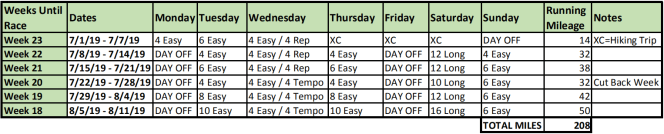
Long before I reach the end of this schedule, I’ll have my answer.
 Quest To Qualify
You must be logged in to post a comment.