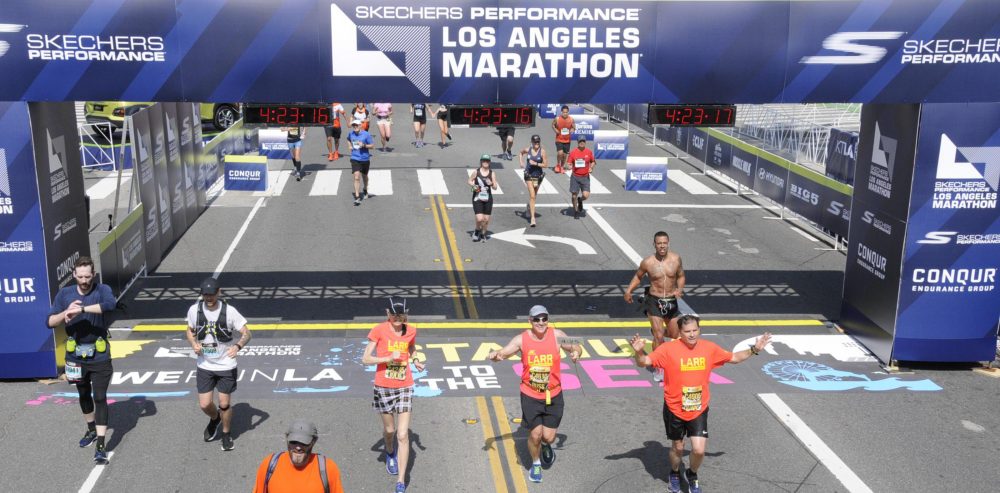
Six months since my last blog entry. I promise to do better, etc. But trust me, I have made major improvements in my training in the quest to run a Boston qualifying marathon time. And rather than bore you with a long narrative about what has been going on, I present for your approval a gaggle of quick hits. Think of them as tweets from a runner who has been too busy for mere words.
INJURIES:
Currently suffering from a very painful Morton’s Neuroma, aggravated by a marathon that featured a run on a heavily cobblestoned beach path in Ventura. More later.
Other than that? Doing fine.
COVID:
Never caught it. Fully vaxxed. But due to the spreadability of the virus and its rather unpredictable nature on a given human body when infected, gathering and running in large groups is forbidden. However, weekly Saturdays runs have continued in small groups of runners who are part of my “circle of trust.”
LA MARATHON:
After being told for nearly a year that we will be “the first big race to return,” the Los Angeles Marathon has been postponed to November. Since I am pacing the marathon this year, and since that task also requires me to lead Saturday group runs at a specific training pace, it means that training to pace thismarathon will be a summer affair, as opposed to a winter one. And if the 2022 edition of the LA Marathon takes place next March, I will be leading Saturday runs for the next nine months. Which may or may not impact…
FUTURE MARATHONS:
But first, because I don’t want to get ahead of myself:
CURRENT TRAINING:
For the last several months, I have focused my training on one, and only one, goal: consistency. Consistent training has been the one thing that has prevented me from accomplishing my marathon time goals. This means running as many miles as possible on as many days as possible, as consistently as possible. This has paid off in big ways. For example:
MOUNTAINS 2 BEACH MARATHON
One of my favorite races. A largely downhill run from Ojai to Ventura, with loops on either end to create a full 26.2 mile distance. It was canceled last year, and was nearly canceled this year as well; however, Fast Green Racing, the outfit that “runs” the race (heh) decided to offer two options: a virtual race where you could run the distance anywhere you chose, and a “touchless” version, where you run the official course (with a few modifications) and allow an app on your phone to track your time. The advantage of the touchless version is that it is a Boston qualifier. Since the app tracks you over a predetermined course and logs your time, you qualify for the Boston marathon if you run it fast enough.
That’s the version I ran, but not to BQ. A fellow pace leader organized Saturday runs with the idea of running the race with his group, and he graciously allowed me to run with them. On the day of the race, we convened at the finish line near an outdoor mall in Ventura and carpooled up to the start line. We then ran the “race” together as a long training run, taking our time at a few places along the course where his wife met us in his car with water, Gatorade and snacks. We all finished somewhere between 4:30 and 4:45, with an overall moving pace of 10 minutes per mile, or about 4:25 without counting stops.
Flashing back to the Injuries paragraph earlier, I used the water stop time to massage the ball of my left foot, which calmed down the pinched nerve enough to allow me to continue. But at mile 23, on a 300 meter section of beach path that was cobblestoned with pebbles embedded in concrete (a charming look, at least), each step on a stone was like a lightning bold from my foot all the way up my leg. It was sheer agony, and the only way to avoid it was to run in the sand. Not easy to do 23 miles into a marathon, regardless of how easy we were running it.
Looking forward to seeing my doctor about how to clear this up, because there is no way I can pace a marathon while stopping every five or six miles to massage a nerve.
Ok, enough complaining. Back to…
FUTURE MARATHONS:
Precisely four weeks after pacing the LA Marathon, my plan is to run the California International Marathon in Sacramento as hard as I can, with the goal of taking at least 15 minutes off my best time. This means a time of 3:45, but my moon shot goal is faster than that: sub 3:30. This would almost certainly guarantee me a spot in the Boston Marathon (a runner usually has to beat their time by several minutes to guarantee a spot; just qualifying by a few seconds is often not enough).
This is where all the base building will help me. I plan to use the Pasadena Rose Bowl 5k on the Fourth of July weekend as a VDOT test, which will tell me with near certainty what marathon pace I am capable of running with the right training. I’m hoping it shows me capable of training for a 3:30 pace, but if not, I will train for whatever pace it suggests.
One thing I have learned: it is more important to be process oriented than results oriented. Meaning, if I trust the training, and actually do the training consistently, the results will come.
I need to seek advice on how best to train for CIM while still performing my duties as a pacer for LA. The group I am pacing is shooting for a 10:00 per mile race pace, which means that on long training runs I will be running 10:30-10:45, with occasional 10:00 per mile marathon simulation runs. This builds endurance, and certainly qualifies as race pace endurance training for where I am at now, but will not help with race pace endurance at 8:00-8:30/mile for CIM. My mid week training runs will reflect my suggested CIM pace, but I will need to find a way to gain race endurance for CIM other than long Saturday runs. And since there are only four weeks between LA and CIM, most of my time during those weeks will be spent in recovery, tempo, sharpening and tapering workouts. But the LA Marathon coach is very knowledgeable, and there are many other resources available as well. But the main hurdle for me is, and was, and will probably always be:
CAN I CONTINUE TO TRAIN CONSISTENTLY?
 Quest To Qualify