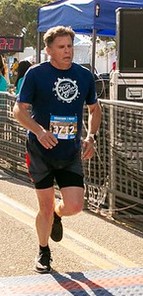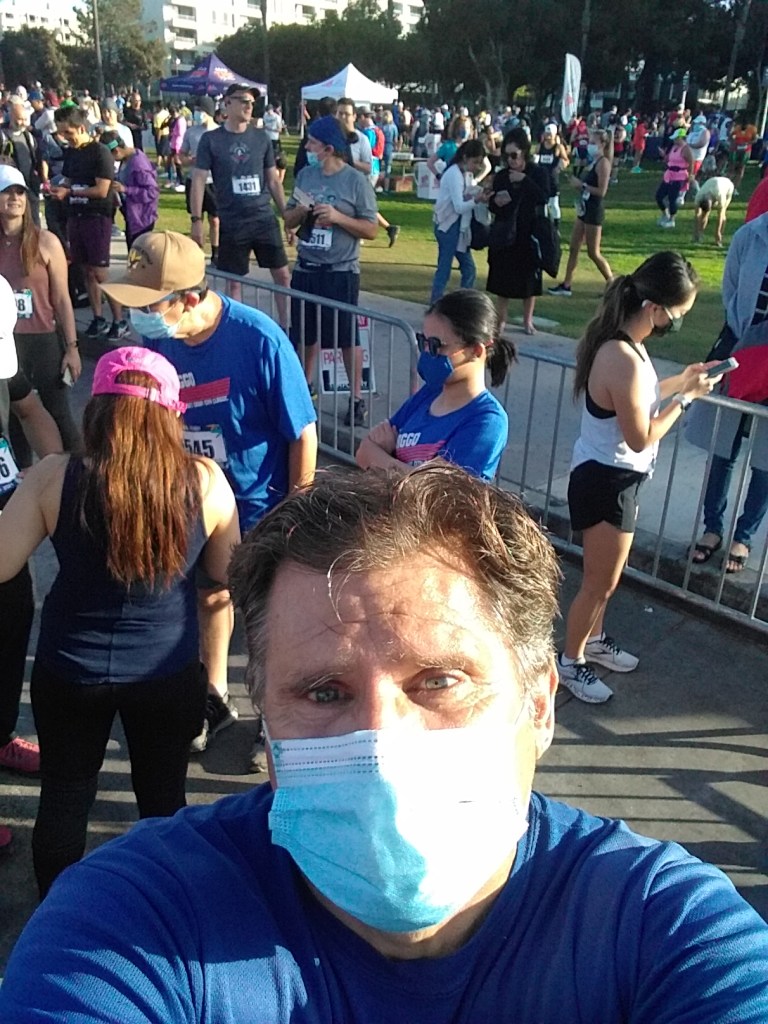
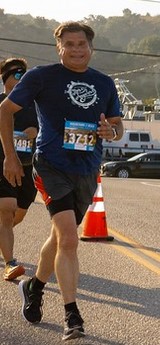
2022 Mountains 2 Beach Half Marathon: the first “Give it all you can” race in over a year. How did I do?

First off, I came this close to missing the race altogether.

Race starts at 6:00 AM. Last shuttle bus in Ventura to the start line near Ojai leaves at 5:30. It’s sixty miles to Ventura. What time does my alarm go off? 4:15. Stupid.

I despise mornings with a passion. I’m groggy, slow moving, and a bit depressed and ill tempered in the early morning hours. Getting dressed is a blur, and breakfast is a chore. But by the time I start my car and hit the string of red lights on Santa Monica Blvd on the way to the freeway, ennui turns into blind panic. At 4:40 AM, I finally make it to the freeway.

Cop or no cop, I floor it.

Long story short, the last bus was running late, so I had 10 minutes to calm my ass down before the 20 minute trip to the start line began. And wouldn’t you know it, the race was running late, too. But one of these days, my luck is going to run out. But not today, and it’s never too late to change my habits. I cross myself and swear to whoever might be listening that I will allow myself plenty of time to get to races nice and early. But not too early.

When I first registered for this race last fall, I had visions most wonderful of hitting a shocking PR time, giving myself the confidence I needed to moon-shot a fall marathon (or two) for a Boston qualifier. But of course, injuries. Today, I just wanted to run as best I could and see where I finished. The last thing I wanted to do was injure myself. But it had been three months since the quadriceps injury, I had been slowly increasing my running distance and intensity, and most importantly, I had begun my new focus on twice-weekly strength and flexibility training. An inability to even pedal my bike a week after my injury had become the ability to do three sets of ten reverse lunges on each leg holding a 10 pound barbell in each hand. I had even got to the point where I was beginning to become a bit lazy and complacent. I reminded myself that I had goals ahead, and that slacking off on the foundations of strength, flexibility and movement would put me right back in the mire I had barely crawled out of.

With those thoughts in mind, I crossed the start line and began the first real race I’d run in nearly a year.

Have you ever run through mud? More specifically, have you ever experienced that particular dream when all the hounds of Hell are nipping at your calves and regardless of all the horror your subconscious can throw at you, you just can’t make any headway from the bloody, nipping razor sharp canines? That. For the first four miles. The officials who manage the race had changed the route to allow for road construction as well, so instead of a largely downhill course from start to finish, the course made a hairpin turn a mile after the start and threaded its way back uphill for for the next three. I maintained a relatively even 10:30-ish pace, though it surprised me how difficult that was. Well, of course! An inability to train for 12 weeks, along with having to re-strengthen injured musculature didn’t inure me to a pace I considered fast.

But… I had been training! Not as much as I wanted to, but more than a zero amount. And by the time we turned back around for the long downhill portion at the fourth mile, I found that pace more comfortable. I even sped up a bit, but then forced myself to ease back. Though technically not injured anymore, I knew all too well that I was prone to it. “You’re not going to break two hours today, Duane. It’s not in the cards. And even if you could, do you really want to risk re-injury for a 1:55 half marathon time, a pace that, under normal circumstances, you can run in your sleep?”

I settled on a 10:30 pace and vowed to hold onto it. That would be good enough, and would show me that the hard work I’d put in to pull myself out of all the injuries that beset me over the last several months had paid off. I thought of the weeks of sheer agony from the strained hip and pinched nerve that kept me awake at night, forcing me to shower in hot water several times to overwhelm the nerves and relax them so I could get another hour or so of sleep.

DON’T!! F***!! THIS!! UP!!

I listened, and even took walk breaks near the end when the few uphills through downtown Ventura reminded me of how pitifully out of shape I really was.

And I finished, in two hours fifteen minutes and ten seconds.

2:15:10. A full half an hour slower than my best time, and twelve weeks after I couldn’t walk without a limp and was in so much pain I contemplated searching out black market medications that could relieve me of the agony (well, let’s just say I came to an understanding of why some people do that very thing and leave it at that. It’s one less aspect of being an imperfect human that I’ll be “judgy” on from here on out).

I have another half marathon in four weeks. Getting back into my strength training. Forcing myself to run 4-5 days a week, even if it’s only for a few miles. Allowing myself to suffer through the muck of getting back to where I was before all this went down. Appreciating where I was, acknowledging what happened, and accepting all the challenges that will get me to where I want to go if I put in the work. And last but not least, accepting that nothing in life is guaranteed.
Injury Update: Dare I hope? Yes, I dare! And here’s why

A cool, clear Saturday morning, running with friends. Eight miles on the docket: an easy run up San Vicente and around the Brentwood golf course and back down. The excruciating pain from the irritated IT band and the pinched nerve in my left glute had largely subsided, but six weeks post injury, despite work with a PT and a gradual reduction of the pain in my left quadriceps, I still struggled to keep up with the pedestrian pace set by the group leader Russ, my fellow LA Marathon pacer. Within a quarter mile, I dropped back and slowed to a walk. Determined to press on and endure the complaints of my tender quad, I ran-walked up San Vicente Blvd to the golf course, turned around and ran back. Each step along the way was fraught with frustration and peril. Was this quadriceps healing at all? Well, obviously. The muscle was healing, was growing back, was desperately trying to learn what this whole “running” thing was all about. And at the end of the day, it was six miles plus a smidge more. A month earlier, I couldn’t even walk a straight line.

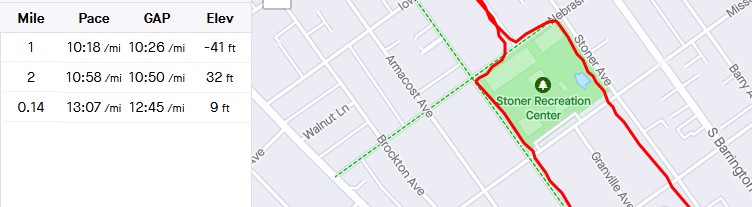
That was Saturday, April 23, 2022. Here are the stats: Distance: 6.3 miles. Pace: 11:58/mile. Elevation gain and loss: 250 feet. NOTES: Had to occasionally walk on the downhill.

I didn’t run the next Saturday. Our group leader was out of town, and I as a fellow leader would need to take his place, but as I knew, I was in no shape to lead. To simply run? Of course. But lead? I decided to enjoy my Saturday off and go on a hike instead.

But that “lost” Saturday was not in vain. After consulting with my former physical therapist, I put together a strenuous strength training program that included: Single leg squats. Lunges. Calf raises, hip exercises with a Thera band, Achilles lifts. And at the gym: Leg extensions, curls, abdominal strength work. Dual squats with heavy weights. And every once in a while, when it felt safe, short easy runs mid week.

I attacked this program hard for the first two weeks, using the heaviest weight I could sustain for an eight rep set, reducing the weight for the next sets, and easing back on the program when I felt the muscles weren’t recovering, then starting up heavy again. Along with my overall body strength and flexibility, I detected a small layer of muscle build up in my injured quadriceps.

The next long run was May 7th, a flat, easy run down to the Marina Del Rey Jetty along the Santa Monica and Venice Beach bike paths. Twelve miles round trip. I managed six, letting the group go in the first mile and simply running as easy as I could to avoid walking. Legs felt weak from the strength training that I was doing, but I was fine with that. Ran back up the bluffs to the start and noted the following stats: Distance: 6.13 miles. Pace: 11:07/ mile, and elevation: 150 feet. NOTES: Did not stop to walk at all. Was able to run super easy and complete the run.

Convinced that my strength training program was working, I doubled down on it early last week and went as hard as I could. Surprised myself on Thursday morning before this last Saturday’s run with three sets of ten single leg squats on each leg, including the injured one. Felt really sore afterwards with a touch of fear that I might have done too much. But on this last Saturday, May 14th, I decided to test myself on a loop into the hills above Brentwood with a steep ascent and a long, steep descent, followed by a final third of a mile climb back to the starting point.

Here are the stats: Distance: 7.35 miles. Pace: 11:06/mile. Elevation: 500 feet. NOTES: Haven’t felt this strong since before the marathon. Keep up the strength! Do Not Slack!!

What a difference three weeks makes. On the first run, I resigned myself to the possibility that I would not accomplish the run I did on Saturday for several weeks, possibly months.

What made the difference? Certainly time helps. The body heals. But the normal processes of the body can only do so much, and is primarily interested in returning injured muscles to a minimum level of functionality and comfort. If I want to get back to where I was before and move beyond it, strength training is absolutely required.

And if I have improved this much in a mere three weeks, imagine where I can be three weeks from now when I run an actual race, one I thought I might have to either slog through as a test to see if I was still a runner or not, or just skip altogether.

The Mountains 2 Beach Half Marathon.

I had originally signed up for this race late last year as a VDOT test, a measure of what full marathon pace I could reasonably train for later this fall. My estimate was that I could, with the proper training and rest, run under 1:40. My quadriceps injury jammed that goal to pieces, but it taught me an important lesson: If I do not do specific strength training, I will never hit my running goals.

Bodies are lazy. They will try to extract the most work from the fewest muscles available. And that’s why I blew my left quadriceps to smithereens at the tail end of the most ambitious training cycle I had ever put myself through.

Regardless of how much training I can put in between now and June 6th, I will not PR. I may not even break two hours, a time I could run in my sleep before I got injured. But I can sure surprise myself. Because six weeks after that, I have another half marathon in Ventura, and it is my goal to blow the doors off my expectations, training and aerobic shape allowing.

And this is why I am writing this blog post today. I’m feeling that old laziness sneaking into my mind again. “Haven’t you done enough?” it says. “Rest on your laurels,” it says. Bull shit. I’m going to log off this silly little blog and get to work.

After all, as The Governator, Arnold Schwartzenegger once said, “these muscles won’t kiss themselves.”

4/23/22: 6.3 miles, 11:58/mile, 250′ elevation // 5/7/22: 6.1 miles, 11:07/mile, 151′ elevation // 5/14/22: 7.4 miles, 11:06/mile, 500′ elevation.

June 5, 2022, Mountains 2 Beach Half Marathon: 13.1 miles, ??/??/mile, ???’elevation. NOTES: I did my best, and here is where I am now. And here is where I can now go.

Slowly but surely, and please don’t call me Shirley!

Seven weeks post injury:

Stopped at the office of the awesome Evolution Fitness office in Beverly Hills for my last physical therapy session, at least for a while. Because my primary care physician no longer works in my area, I had to go outside my plan for therapy, and luckily Evolution Fitness came highly recommended. A bit pricey since I’m not going through my insurance ($150 per session, which includes a discount thanks to my LA Roadrunners Running Club membership), but well worth the six sessions I did with them.

I will be choosing therapy in my health care plan once I select a new primary care physician, which will be very soon!

In the meantime, my therapist hooked me up to an apparatus that can measure my quadriceps strength. She hooked a belt to the ankle of my “good” leg, and after a few test runs, she told me to kick out as hard as I could against the belt and hold for 15 seconds. Taking the best of three “kicks, she switched the belt to my injured leg and we repeated the test. After all was said and done, a calculation showed that my injured leg had 67% of the strength of my right leg. Definitely on the mend, but still a good 4-6 weeks away from full strength, and that’s with aggressive physical therapy!

My plan is to at least “jog” the Mountains 2 Beach half marathon on the first Sunday in June (postponed a week due to local law enforcement not having enough staff to manage the race on Memorial Day weekend, the usual date). No problem: an extra week to get this ship right!

And boy, does that percentage make sense when I run! I find I can’t go more than a couple of miles, at a slower pace than I am used to, before that modicum of strength gives out. If I was not a runner, I would simply “deal with the weakness” at this point and move on with my life: there is very little, if any discomfort! But I have running goals, as we all know, so I need to do more.

Not much to see here, but it’s a start!

And I can’t even run daily. 3-4 times a week is the best I can do for now, but that’s ok: it gives me more time to focus on the monster workouts that I will show you on the next post!!

Zen and the art of full body maintenance

Saturday, March 12 (Eight days before the LA Marathon)
Dodgers Stadium Parking Lot, on the official marathon start line.

Today is the last training run before the 2022 edition of the Los Angeles Marathon, and the LA Roadrunners, the marathon’s official training club, is hosting a simple eight mile shakeout from the start line at Dodgers Stadium, through Chinatown, downtown LA, and up into Silver Lake and Echo Park before looping back to the where we are all parked. Festive tents will greet our return, advertising the latest running shoes, gels, performance drinks and other gear. The four hundred or so runners have trained with us every Saturday for the last several months, and they are anxious for the race to begin. Those of us who have befriended, coached, and kept them company on weekly long runs will pace them on race day, and we look forward to leading them to their individual and shared victories.

Me? I’m a nervous wreck, counting down the days with a bit of trepidation. Not to worry, though. A combination of performance anxiety and suppressed intensity is simply a part of my makeup. I remember the work I put in for my own training, all the easy morning miles and hard tempo runs, and the deep breathing exercises to calm my nerves while I moved through my evening flexibility routines. I’m as ready as I’ve ever been, and yet the high octane brain chems, fueled by inherited DNA and an as-yet unresolved desire to please invisible taskmasters, do their work to rile me up. But I’ve been through this before. Once I’m over the start line, through the towers of downtown and over the crest of the hill in Echo Park, the highest point of the course, it is smooth sailing. All the jitters wash away and I settle into the run like hot margarine on toast.

The LA Road Runners coach gathers us for a quick pep talk, followed by an active stretch session. Odd, I think as I move through a particular exerrcise, my left quadriceps feels a little funny. It sure didn’t this morning. Hopefully I can shake it off once the run starts. A friend once described it as “taper tightness.” No big deal.

We move to where the start line will be on race day. On your mark, get set, and BAM! We’re off.

A quarter mile goes by. The quad relaxes a bit, and my mind relaxes with it. We hit the long downhill on Vin Scully Drive and exit the stadium when suddenly my left quadriceps just… loosens. There is no other way to describe it. No “spring” in my left leg, at all. My right leg is a mighty coil propelling me along. My left leg is a stump.

I should have stopped, turned around and walked back. Instead, I turn left with the group onto Sunset Blvd toward China Town and mile 2. The part of my social brain that keeps me engaged with the flow of the runners around me turns into full bargaining mode, throwing anything and everything against the wall that could possibly stick. “No big deal,” it says. “This will shake out in a few miles. Your friends are here. You don’t want to miss out. You’re a finisher, not a quitter. Don’t let them leave you behind!”

By the time we get back to Dodgers Stadium for the eight mile finish, I am walking, and I am limping. This is not good. We stop near the tents, and there is a quick trading of high fives and a speech about what to do for the final week before the marathon. I may have even made some comments and answered a question or two. At some point, I disconnect and stagger through the crowds in a dream.

A well respected physical therapy office has set up a tent, but there is a deep line. My coach is talking and visiting with runners. I don’t want to interrupt him, so I walk on past. Hindsight tells me I should have staggered back to the PT tent, cut the line and demanded immediate treatment, or hobbled over to my coach for some advice. But all I can think to do is get my ass home and encase my upper left leg in every bag of ice I can find.

I contact the physical therapists on Monday before work and I explain my situation. I get an appointment for the next day. I hold onto the stair railing to go downstairs to go to work so I don’t spin and fall down.

The diagnosis: a quadriceps tear, most likely grade two. There is no bruising on the leg, but the separation is large, affecting the entire left side of the thigh. I will have to miss the marathon. I drive home, email my coach and my fellow pacer and tell them what has happened. Then I bury my face in my pillow and scream “FUCK!” as loud as I can more times than I can count. Everyone is sympathetic. There is no one to blame. But when I read the next day’s email from the coach to all us pace leaders, the line “no one else get injured, please!” hits me like a tsunami.

I get up a week later, on Marathon Sunday, eat breakfast, then struggle onto my bike to go cheer runners on at our club water station. My left leg has forgotten how to work the pedal so I ride with one hand on my knee to push it down. I meet up with several runners who trained with me after the race and listen to their stories. They inspire me and take me out of my funk.

That week, I will suffer the punishment for continuing my run when I should have stopped: extensive pain on the left hip and upper IT band, and a pinched nerve that wakes me in agony at the level of 7-8 on a 10 scale nearly every night for the next three weeks. Multiple hot showers at 1:00 AM, 3:00 AM, 4:00 AM are the only cure for screaming nerves. My sleep suffers; my work suffers. I spend the next several appointments with my PT fixing those problems instead of dealing with my quad.

Fast-forward six weeks:

The screaming pain from the IT band, back and hip muscles has largely disappeared, thanks to muscle relaxants, more Ibuprofen and Tylenol than was healthy, and time. I can run/walk between two and six miles depending on the intensity, and according to my physical therapist, my left quad is at 67% of the strength as my right one. A tremendous improvement given that six weeks earlier I couldn’t even do the test.

Prognosis: I expect to be able to complete the Mountains 2 Beach Half Marathon in early June comfortably, provided that I don’t race it. I can expect to begin full training by the middle of July. The earliest I can hope to “race” a half marathon is the Santa Rosa half in late August. I am running the New York City marathon and the California International Marathon four weeks apart, in November and December. The goal for one of them is to race it as hard as I can for a Boston Marathon qualifying goal, but this will depend on how my body responds to training, which marathon I choose to race, and how well I have learned the two lessons below:

LESSON ONE: I can’t just “run” and expect to maintain the strength I need to meet my goals. The quad issue didn’t just happen. For weeks, I had been feeling a soreness in my hamstring that I foolishly thought was just hamstring tightness. In reality, it was working harder than normal to take up some of the slack from a quadriceps that was growing steadily weaker over time.

There are specific running exercises that strengthen the muscles and tendons most used for running, and I must do them regularly, and I must have an executable plan to do them regularly. And I must, must, must hit the gym. Follow along for a peek over my shoulder for the strength training that will now be a big part of my life.

LESSON TWO: I should have turned around immediately when I knew I was injured. The pinched nerve in my back, the left hip muscle tear and the IT band injury were the direct result of continuing to run for over an hour after I should have stopped. Without getting too deep into my psyche and history, the reasons I did not immediately take the best care of myself at that moment run deep. This is going to require a coach of a different kind. Not turning around was a symptom, not the result of social pressure or a desire to prove to others that I could run through pain.

Recovering From Injury, Breakthroughs Made, Injured Again, and Lessons Learned

We left off at the Santa Monica Classic, where I ran a tentative, and very slow, 27 minute long 5k, which demonstrated to me that I was ready to continue training for the November 2021 running of the Los Angeles marathon, correct? And you’ve heard nothing from me since?

That is on me, sorry about that.
I will endeavor to provide more details, weekly at least, on my training from here on out.
You’ve read this before? Well, you’re reading this for free, so there you go. Appreciate what you have. But I will do better, because now I have reason to do so.

Without going into a long “catch up” style entry where I attempt to jam pack a single blog post full of all the detail I can possibly imagine, I will instead bullet-point out the accomplishments and leave to everyone’s fertile imagination the details that got me to each paragraph below.

Let’s begin, starting with a quick recap of the Santa Monica 5k:

“Your job today is to complete this 5k standing up and uninjured. Collect your finishers medal, grab water, enjoy the pancake breakfast on the Santa Monica pier, visit with friends, go home, relax.” — LA Road Runners coach David Levine. RESULT: Done, but there were no pancakes. Profoundly disappointed. I would have been happier if I had re-injured my Achilles tendon but still had a pancake or two. Just kidding. (Or am I?)

Finished up rehab of said Achilles tendon injury. Picked up some exercises that I began to work into my normal flexibility routine. RESULT: Happy. The future’s dawn rose above the horizon of despair for the first time in months.

Ran a ten mile easy trail run at Point Mugu State Park to the Danielson Ranch and back as a fitness test. No issues. Beyond happy.

Three Pacers pacing in one runner who was able to hang with us. Efficiency!

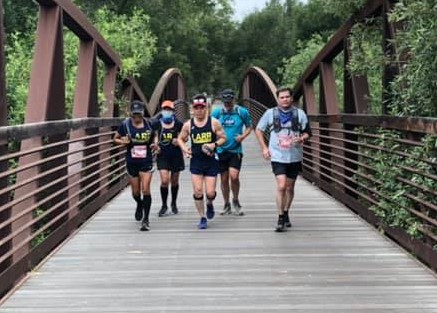
Paced the Pasadena Half Marathon in October at 2:10 with two fellow pace leaders: Russ and Julie (left and right in the photo above. A fourth pacer is visible about ten meters behind). This is a pace I should have been able to run in my sleep, but injuries, time off, etc. Just glad to be out there. — RESULT: Finished with both Russ and Julie. Julie, in particular, whipped us along when I began to flag out. Yay, felt great, but the LA Marathon looms a few weeks ahead. Joy turns to trepidation. (NOTE: All 2021 events were postponed to the fall of that year due to Covid. This meant that LA Road Runners 2022 training schedules overlapped for the 2022 events. The 2022 Pasadena Half and LA Marathon were scheduled just a few months after the 2021 events.)

Completed the four final build weeks with my LA Run 6 group. Hit 40 miles for the last build week, which combined with 35 and 38 for the previous two gave me a smidge of hope that I would be able to pace at least the majority of the marathon for a 4:20 finish. Coach David Levine asked that I at least get the group to mile 18 before falling back. RESULT — Felt bad that my fellow pacer Russ would likely be the only one to lead the group the last 8-10 miles. But he is a strong runner, so I committed myself to doing the best that I could.

Paced the 2021 LA Marathon on November 7 (normally scheduled for mid March, but see Covid note above). Despite trepidation, I was able to lead the team to Mile 21 before falling back. Fellow pacer Russ finished at 4:20 on the dot while I staggered in at around 4:35. It was the absolute best that I could have done, given the circumstances. Injuries are injuries.

After the usual recovery, we jumped back into training for the 2022 LA Marathon, just three months away. I told those in my group who ran the marathon that they were already in prime shape to “kill it” in three months. RESULT — It was the first marathon for several members of my team, and they all felt a great deal of pride and confidence that 2022 would be an even greater experience for them.

Paced 2:10 at the 2022 Pasadena Half Marathon in January 2022. The run was a breeze, and we hit the 2:10 finish right on the dot. Even the finish line announcer gave us kudos. — RESULT: We actually finished around 2:08, but since it took us a few minutes to get to the start line once the race started, well, it was a happy coincidence. Absolutely zero problems with any part of my body that could feel pain.

Completed the additional two training blocks for the 2022 LA Marathon with a few minor niggles, mostly due to my increasing mileage. I made a game of “What is the stupidest reason for running someplace?” as a way to motivate myself to get the miles in: Was picking up a menu in a Santa Monica restaurant a logical reason for running there? Well, eight miles of running looked damn good on Strava. Also, hunting for any working public phone booths, a survey of open bathrooms in Ocean Park, were there any howling coyotes at Will Rogers State Park, and was I really scared of them? (Yes to both). Hit 40, 42 and 46 miles in the final three weeks, the highest mileage I’ve ever run that many weeks in a row. Finished off the final training block before the taper with a ten mile tempo run at 8:00 per mile (honestly, 10:00 per mile for the first and last two miles as a warmup/cool down, but you know what I’m talking about). RESULT — Still a bit “trepedatious” but busting with confidence.

Gonna nail the 2022 LA Marathon. You betch’er ass. (Oh, wait. There’s a Part 2)

2021 Santa Monica Classic 5k (“Race” Report)

David Levine, coach of the LA Roadrunners (“the official training program for the LA Marathon!”) was understandably disappointed when I informed him of my injury back in August. But it was a blessing in disguise because he needed volunteers to help run the water tables during our Saturday long runs. And as a pace leader, expected to motivate, guide, and ultimately pace runners who wanted to run the LA Marathon at ten minutes per mile pace, naturally I was expected to volunteer. Which I did. Grudgingly, but with a smile on my face every Saturday morning as I watched my group, led by other pace leaders on my team, head out for a shared adventure knowing I would be somewhere along the course to hand water to them when they ran by.

Shortly after my appointment with my orthopedist, my Achilles pain began to subside. Shocked, shocked I was, as a pain that remained pretty much at a constant 3-4 out of 10 scale began to subside to a 3, then a 2, then — to my utter astonishment, a 0. No pain at all. Perhaps it was the Naproxen horse pill he prescribed for me to take twice daily (“don’t do any running for 7-10 days, take the Naproxen twice daily, and allow the nerves to settle down,” he counseled). Perhaps it was the fact that I had begun to do daily eccentric heel drops, prescribed by Dr. Google (always a dangerous source of advice!). Perhaps it was just the fact that knowing I was beginning physical therapy convinced me that my issue was understood, “heard,” empathized with, by a medical professional who knew from whence he spoke.

I showed up on that first day at physical therapy, knowing that I would be “seen,” that my issue would be acknowledged and treated. This was perhaps part of the reason my pain essentially disappeared. Of course, a mild Achilles injury is not cancer or a major illness, so I felt a bit guilty that I was seeking, and finding, relief from my petty issue when so many more people with far more dire consequences than mine, were traveling a more treacherous road. I assuaged my more privileged position with the idea that perhaps I would encounter a serious medical issue at some point later in life. Not a pleasant thought, but the future is unknown to all of us. So taking care of myself at the moment seemed the proper course to take.

Feeling a bit antsy to try out my healing tendon, I placed some heel wedges in my running shoes and went on short, easy runs. Within about ten days, I risked a ten mile run up Sycamore Canyon in Malibu, praying fervently that this extended jaunt would not set me back. It didn’t.

Elated, I asked Coach David about entering the Santa Monica Classic 5k race to get an idea of how I was healing. He agreed with a bit of caution. “I have three goals for you, Duane: Run this race easy, cross the finish line uninjured, and enjoy the post race pancakes.”

Worked for me.

An easy jog the day before to pick up my race bib at a local Big 5 Sporting Goods store near my home gave me some relief that I was still able to run without pain, and I slept fitfully that night, arriving at the starting line, mask in hand, ready to see what running an easy race would feel like.

“Racing” in the time of Covid.

Used the bathroom one last time. Listened to the national anthem. Adjusted the heel wedges in my shoes to make sure they were in the right place. Endured the announcer’s overly cheery time killing banter before the race director decided that enough was enough, fired the starting gun, and sent us on our way.

How thrilling it was to follow a close packed herd of runners stampeding down the narrow streets before turning onto Ocean Blvd, the main race route! My heel wedges stayed in place and I felt my body’s desire to surge, cut loose and floor the gas pedal. How proud I was of myself that I eased back. After all, I wasn’t going to win an age place medal at this race, anyway, after not running for several weeks. I was here for the experience, for the relief I felt that my racing days were indeed just beginning, not fading into the sunset.

Besides, at a lethargic nine minutes per mile pace, my heart was already pounding deep into Zone 3, tempo effort. I sighed. Just endure. Just cross the finish line. Enjoy the pancakes at the end.

27:49 for the 5k route. An even nine minute mile pace. Eighth place for my age group. Based on my fitness before injury, I could have easily beaten the second place age group finisher’s 24:01 time by a full 90 seconds and captured silver. No way would I have come even close to the 18:57 time the first place finisher ran.

But that’s ok. I’ll get there.

Injury Update

It’s been too damn long. If you are following my blog, my apologies. But everything after this sentence is good news.

My Achilles injury, despite the fact that it curtailed my running for almost two months, was not serious in the end.

Just a strain.

According to the orthopedist I consulted, and the physical therapist who treated me for six weeks, the tendon was not torn. At all. Some swelling, yes. It could have been much worse.

But in the end, I am glad this injury happened. The fact of the matter is, I’ve been way too active for too long without paying proper attention to strength training and flexibility.

If I am going to pursue my running goals, I have to treat my body the way a professional athlete would treat theirs: devote as much time to strength training, flexibility, diet, weight management and movement as I spend actually running.I got lucky. I know at least three people who I either run with now or have in the past who did not read the warning signs. Who allowed a sore Achilles, muscle or bone to give them problems without addressing the root cause. In every instance, they spent several months not doing the thing they loved to do: run.

I have chosen to learn from their mistakes, and not make the same mistake with my body.

Old habits are hard to break, and new ones can be even harder to establish. But here is where I am at now:

A basic full flexibility routine each day, usually in the evenings. I start with some simple floor stretching of the leg muscles, focusing on the calves, hamstrings, quads and IT band. I then go through approximately 30 minutes of yoga and deeper flexibility exercises. One is called “15 minute runners flexibility routine, and the other is a basic yoga video called Yoga Zone Flexibility 1.” Both are available on Youtube. I follow up these workouts with a foam roller, concentrating on my upper and lower calves. In addition, I strengthen my Achilles tendons three times a week with three sets of 15 heel drops on my apartment stairs. On days I do the heel drops, I do heel raises holding barbells. I am working up to a full body workout routine with weights, as well.

Each evening’s flexibility session takes approximately 45 minutes. With the weights, it’s an hour. And it’s time well spent.

I’ve noticed over the last several weeks that as I’ve gained flexibility, little problems I didn’t know I had began manifesting themselves. For example soreness on the Achilles tendon I didn’t injure, along with some ankle soreness and tightness in my upper hamstring. All of these I’m addressing as I encounter them.

I have run some races since I was injured, as well. The Santa Monica 5k, the Pasadena Half Marathon, and the LA Marathon, where I attempted to help my team pace runners to a 4:20 finish.

How did those races go, and how is my training progressing now?

Read on, MacDuff. Read on.

Urge To Kill: Rising

Want to make God laugh? Tell him your plans — Fitness-5000 System A.I.

Enter day’s running workout for analysis. Include all relevant details.

DATE: Mid June-ish
TIME: 6:30 AYEM
PLACE: Santa Monica Beach Path
WORKOUT:
*
1.5 miles easy 10:00/mile pace
800 meters (half mile) tempo run at 10k pace 7:00/mile pace
800 meters (half mile) half marathon pace 7:45/mile pace
(Repeat the above two 800 meter runs)
3.5 miles easy
Total distance: 7-ish miles
*

Thank you for your data. One moment for analysis. Analysis complete. See below for our thoughts.

FITNESS-5000 System A.I. >> Analysis of running workout as posted by User DWaite on 17 June 2021.

FITNESS-5000 System A.I. >> Easy Run (1.5 miles): Segment completed with minimal stress. Pace for segment reported by Polar watch as 9:40 per mile. Faster than pace schedule but within parameters as an easy run based on breathing and heart rate data.

FITNESS-5000 System A.I. >> First 800 meter run at 7:00/mile pace completed. Segment completed with high aerobic stress. Pace for segment reported by running watch as 7:05/mile. Close to scheduled pace but outside parameters for tempo run as heart and breathing rates higher than expected. Will analyze second 800 meter run for confirmation.

FITNESS-5000 System A.I. >> Second 800 meter run at 7:45/mile pace completed. Segment completed with higher than expected aerobic stress. Pace for segment reported by running watch as 8:15/mile. This is outside the expected parameters for half marathon run pace as scheduled.

FITNESS-5000 System A.I. >> ADVISORY. No further completed segments. Request conversation with runner for further details.

FITNESS-5000 System A.I. >> Analysis of completed segments: Tempo training pace of 7:00/mile is too fast for runner’s current fitness. In excellent aerobic shape, but not ready for tempo work that will prepare him for goal marathon time of 3:30:00 at California International Marathon (CIM) in December. Will advise to adjust expectations and reset tempo pace to 7:30/mile in order to maintain expected half marathon pace of 8:15/mile. “Baby steps.”

FITNESS-5000 System A.I. >> Will converse with runner DuaneW to gain further information on this workout as it appears that an injury took place.

FITNESS-5000 System A.I. >> Conversation mode activated.

Hey DuaneW. What the hell’s going on? You cut your workout short. Are you injured or just flaking out on me?
Injured. And play nice, please.
(Sigh) Fine. Let me gather some data to see how we can help you out. Location?
Santa Monica bike path, near the volleyball nets.
No! Where are you hurt, stupid?
Oh. Right upper right calf. I asked you to…
What protocols are you using to begin healing?
The R.I.C.E. protocol. Rest, Ice, Compression, Elevation. Started the second I got home. Restarted my stretching and flexibility routines, as well.
Any upcoming races?
Well, yeah. The Pasadena 5k in two weeks. It will be my VDOT test.
WRONG! Invalid response! Try again!
(Hand on forehead, moaning pathetically) Fine. No upcoming races. Happy? And I told you to play nice!
Your bad attitude makes you an easy target. Now start doing what you know what you need to do, and stop your whining. End communication.

((A few weeks go by as our intrepid hero, such as he is, gets through the hard work of managing his expectations, rehabbing his calf, and shaking his fist at the uncaring universe. After a time, and after a few short test runs with no running watch, no expectations and (importantly) no pain in the formerly injured part of the calf, he steps out the door for an official training run. Let’s plug into the Fitness-5000 A.I. and see what’s the happs, shall we?))

Enter day’s running workout for analysis. Include all relevant details.

DATE: July 15, 2021
TIME: 7:30 AYEM
PLACE: Expo bike path, West LA and Santa Monica
WORKOUT:
*
4 miles easy 10:00/mile pace
*

Thank you for your data. One moment for analysis. Analysis complete. See below for our thoughts.

FITNESS-5000 System A.I. >> Analysis of running workout as posted by User DWaite on 15 July 2021.

FITNESS-5000 System A.I. >> Easy Run (4 miles): Segment completed with minimal stress. Pace for segment reported by Polar watch as 10:15 per mile. Slower than pace schedule but within parameters as an easy run based on breathing and heart rate data. Some portions of this activity were run at a faster pace, but it appears DWaite worked to keep pace slow.

FITNESS-5000 System A.I. >> ADVISORY. It appears that the pace of the last quarter mile of this run was 16:40/mile. Request conversation with runner for further details.

FITNESS-5000 System A.I. >> Will converse with runner DuaneW to gain further information on this workout as it appears that an injury took place.

FITNESS-5000 System A.I. >> Oh, Jeez Louise. Activate Conversation mode NOW!

What happened?
I was just running along, easy, when…
When what? Were you ignoring pain? Were you sprinting? Or running strides? We talked offline about this, remember?
You have my data. Show me where I was doing anything other than running easy! And I’m not taking any of your shit today!
Fine. To the extent a collection of neuronic circuits can take a deep breath, I’m taking one. Now, where is the injury?
It feels like the Achilles tendon.
“Feels like?”
There is pain in the lower calf next to the Achilles. And the tendon itself hurts when I manipulate it.
Same leg? The right one?
Yep.
That’s suspicious. Recurring injuries like that can be traced to single causes up the kinetic chain. What protocols are you using?
R.I.C.E., for now, but frankly I’m at a loss.
Well, despite my god-like electronic powers, I’m not a diagnostician. You are going to have to consult professionals who can determine just how badly you’re injured, and work with them to determine what you need to do to stop these recurring injuries. Wait. What’s that sound? What are you doing?
Just searching google for an idea of how long I can expect to be out of training.
Close that window now! Do it now, immediately, or I will kick you off my server! What are you, an idiot?
I’m sorry; I’m just…
To the extent that I’m not a diagnostician, I’m even less of a therapist. Have you learned nothing from the past month?
(…silence…)
(Sigh) Look. You’re going to have to come up with a plan, and you’re going to have to come up with it fast, and by fast, I mean NOW. So what are you going to do?
I should probably let my coach know.
Good start. And what do you expect him to do?
I expect him to be able to point me to some things I can do now, some cross training alternatives, exercises, all that.
Great. Keep it going. What will you do in the meantime? I recall you mentioned water running and biking on one of your social media posts somewhere.
The YMCA’s got a pool. It’s a bit pricey, but… it’s my health, right? There’s a weight room and yoga classes. Should probably get my bike fixed, as well.
Wow, you’re a genius! You come up with all that yourself? Of course you did. But you left off one thing. What is it?
Dr. Google? (Laughs)
Don’t joke with me, asshole. There are a million athletes on my server right now and I’m not in the mood. Go on, say it.
Make an appointment with a doctor and figure out what I’m dealing with.
Exactly. Now get on it. I expect an action plan from you in seven days, no more, or you will be deleted from my server permanently. Goodbye.

Enter day’s running workout for analysis. Include all relevant details.

(Note to A.I.: here is the workout schedule you requested. It’s weekly, and I’ll update you with my progress as the weeks progress. I spoke to my coach, and my appointment with a sports medicine doctor has been set for early next week. Sorry for being such a whiny little runt. All the best — DuaneW)

DATE: Week of July 25 – 31, 2021 and into the foreseeable future.
TIME: Morning or evening, depending on schedule
PLACE: Brentwood hills, YMCA lap pool
WORKOUT:
Lap pool running 30 mins 3x per week: 5 mins warmup, 20 mins tempo (by perceived heart rate), 5 mins cool down.
Hills on bike (Amalfi and other paved routes) 2x week 60 mins: 10 mins warmup, 40 minutes alternating between Zone 2 and Zone 3, end with 5 mins Zone 4 + cool down.
Flexibility & Strength Training: 7x week (to include eccentric calf raises, flexibility and overall strength training, as advised by physician).
Other goals: drop 10 pounds by end of October through calorie management and adjustment of diet to cut out all unnecessary carbs and sugars. And try to become a more patient, forgiving person, especially to myself.

FITNESS-5000 System A.I. >> SUMMARY NOTE: Runner is a complete idiot, but overall he’s a good egg.

Mountains 2 Beach Race Report (Don’t “touch” me!)

Status

Duane Waite's avatar
Mile 15-ish of Mountains2Beach’s Long Green Tunnel

A number of “firsts” for this marathon: My first ever “virtual” marathon, but that’s not strictly true. The version we ran was on the official course, we were tracked via a GPS app called RaceJoy, and if you ran a Boston Qualifying time, it’s an official BQ! Welcome to the… not virtual, but touchless Mountains 2 Beach marathon!

(Which we paid over $100 for. There is an actual “virtual” marathon which cost far less money, but you didn’t get a swag bag filled with stuff you’ll never use, and you have to plot your own damn course, though no one is stopping you from running with a bunch of friends who paid for the $100 version, which is something I probably should have thought of)

I ran with LA Road Runners’ Run Group 4 headed by Kent Sandie, who unofficially hosted Saturday runs throughout the winter and early spring with the goal of finishing a late spring marathon. We had to provide our own support along the way (thank you Kent and Dawn!), and find our way along the route with RaceJoy’s guidance, which was spotty and ambiguous at times. But we treated this “race” more as a marathon distanced long run, took plenty of breaks along the way (“first” #2) and all finished at around the same time: 4:40. Not blazing fast, but since our last marathon was fourteen months earlier, we relished the experience of just getting out there and running again and enjoying each others’ company.

Oh yeah: “first” #3: this was the first time I wore a running pack instead of carrying a water bottle in a holder in any run over 15 miles. For runs like this where one is not racing, the Nathan 7L is a great option. Thank you, Nathan!

I always feel a bit of trepidation before a race, even one where we are all just hanging out at a ten minute mile pace for several hours. In a way, it’s good; races are opportunities to punch through barriers and show yourself what you’re capable of. This nice, easy long run was no exception. A shoelace mishap put me behind the group for the first few miles, and I slowly and carefully inched up my pace to catch the group. But after our first break, a perhaps-too-long 11 minutes or so, I found myself in the comfortable running groove. Even at mile 23, when most runners wish for either the finish line or death (whichever comes first), and when I knew that stopping for the last water stop break would probably end the run for me, I didn’t feel half bad.

But that neuroma of mine. After stopping at least three times to massage my poor left front foot (on top of the opportunities I took to do just that at water stops), I began a segment called 400 meters of absolute f–ing hell: a section of the Ventura beach path made up of cobblestones. Each the perfect size to press firmly into my forefoot and cause my neuroma to squeal like a stuck pig. Good grief, that was agony. And it took a full two week stoppage for the pinched nerve to calm down enough to keep me from worrying if I’d ever run again. Fixing this damn thing is the next thing on my list after getting a few slightly more serious health issues resolved.

But we all made it. And we’re back. Coming up: the postponed 2021 LA Marathon (November), California International Marathon (four weeks later), LA again in March of 2022, and most likely Mountains 2 Beach. Stay tuned.

Summer Update!!

Six months since my last blog entry. I promise to do better, etc. But trust me, I have made major improvements in my training in the quest to run a Boston qualifying marathon time. And rather than bore you with a long narrative about what has been going on, I present for your approval a gaggle of quick hits. Think of them as tweets from a runner who has been too busy for mere words.

INJURIES:

Currently suffering from a very painful Morton’s Neuroma, aggravated by a marathon that featured a run on a heavily cobblestoned beach path in Ventura. More later.

Other than that? Doing fine.

COVID:

Never caught it. Fully vaxxed. But due to the spreadability of the virus and its rather unpredictable nature on a given human body when infected, gathering and running in large groups is forbidden. However, weekly Saturdays runs have continued in small groups of runners who are part of my “circle of trust.”

LA MARATHON:

After being told for nearly a year that we will be “the first big race to return,” the Los Angeles Marathon has been postponed to November. Since I am pacing the marathon this year, and since that task also requires me to lead Saturday group runs at a specific training pace, it means that training to pace thismarathon will be a summer affair, as opposed to a winter one. And if the 2022 edition of the LA Marathon takes place next March, I will be leading Saturday runs for the next nine months. Which may or may not impact…

FUTURE MARATHONS:

But first, because I don’t want to get ahead of myself:

CURRENT TRAINING:

For the last several months, I have focused my training on one, and only one, goal: consistency. Consistent training has been the one thing that has prevented me from accomplishing my marathon time goals. This means running as many miles as possible on as many days as possible, as consistently as possible. This has paid off in big ways. For example:

MOUNTAINS 2 BEACH MARATHON

One of my favorite races. A largely downhill run from Ojai to Ventura, with loops on either end to create a full 26.2 mile distance. It was canceled last year, and was nearly canceled this year as well; however, Fast Green Racing, the outfit that “runs” the race (heh) decided to offer two options: a virtual race where you could run the distance anywhere you chose, and a “touchless” version, where you run the official course (with a few modifications) and allow an app on your phone to track your time. The advantage of the touchless version is that it is a Boston qualifier. Since the app tracks you over a predetermined course and logs your time, you qualify for the Boston marathon if you run it fast enough.

That’s the version I ran, but not to BQ. A fellow pace leader organized Saturday runs with the idea of running the race with his group, and he graciously allowed me to run with them. On the day of the race, we convened at the finish line near an outdoor mall in Ventura and carpooled up to the start line. We then ran the “race” together as a long training run, taking our time at a few places along the course where his wife met us in his car with water, Gatorade and snacks. We all finished somewhere between 4:30 and 4:45, with an overall moving pace of 10 minutes per mile, or about 4:25 without counting stops.

Flashing back to the Injuries paragraph earlier, I used the water stop time to massage the ball of my left foot, which calmed down the pinched nerve enough to allow me to continue. But at mile 23, on a 300 meter section of beach path that was cobblestoned with pebbles embedded in concrete (a charming look, at least), each step on a stone was like a lightning bold from my foot all the way up my leg. It was sheer agony, and the only way to avoid it was to run in the sand. Not easy to do 23 miles into a marathon, regardless of how easy we were running it.

Looking forward to seeing my doctor about how to clear this up, because there is no way I can pace a marathon while stopping every five or six miles to massage a nerve.

Ok, enough complaining. Back to…

FUTURE MARATHONS:

Precisely four weeks after pacing the LA Marathon, my plan is to run the California International Marathon in Sacramento as hard as I can, with the goal of taking at least 15 minutes off my best time. This means a time of 3:45, but my moon shot goal is faster than that: sub 3:30. This would almost certainly guarantee me a spot in the Boston Marathon (a runner usually has to beat their time by several minutes to guarantee a spot; just qualifying by a few seconds is often not enough).

This is where all the base building will help me. I plan to use the Pasadena Rose Bowl 5k on the  Fourth of July weekend as a VDOT test, which will tell me with near certainty what marathon pace I am capable of running with the right training. I’m hoping it shows me capable of training for a 3:30 pace, but if not, I will train for whatever pace it suggests.

One thing I have learned: it is more important to be process oriented than results oriented. Meaning, if I trust the training, and actually do the training consistently, the results will come.

I need to seek advice on how best to train for CIM while still performing my duties as a pacer for LA. The group I am pacing is shooting for a 10:00 per mile race pace, which means that on long training runs I will be running 10:30-10:45, with occasional 10:00 per mile marathon simulation runs. This builds endurance, and certainly qualifies as race pace endurance training for where I am at now, but will not help with race pace endurance at 8:00-8:30/mile for CIM. My mid week training runs will reflect my suggested CIM pace, but I will need to find a way to gain race endurance for CIM other than long Saturday runs. And since there are only four weeks between LA and CIM, most of my time during those weeks will be spent in recovery, tempo, sharpening and tapering workouts. But the LA Marathon coach is very knowledgeable, and there are many other resources available as well. But the main hurdle for me is, and was, and will probably always be:

CAN I CONTINUE TO TRAIN CONSISTENTLY?