Injury Update

It’s been too damn long. If you are following my blog, my apologies. But everything after this sentence is good news.

My Achilles injury, despite the fact that it curtailed my running for almost two months, was not serious in the end.

Just a strain.

According to the orthopedist I consulted, and the physical therapist who treated me for six weeks, the tendon was not torn. At all. Some swelling, yes. It could have been much worse.

But in the end, I am glad this injury happened. The fact of the matter is, I’ve been way too active for too long without paying proper attention to strength training and flexibility.

If I am going to pursue my running goals, I have to treat my body the way a professional athlete would treat theirs: devote as much time to strength training, flexibility, diet, weight management and movement as I spend actually running.I got lucky. I know at least three people who I either run with now or have in the past who did not read the warning signs. Who allowed a sore Achilles, muscle or bone to give them problems without addressing the root cause. In every instance, they spent several months not doing the thing they loved to do: run.

I have chosen to learn from their mistakes, and not make the same mistake with my body.

Old habits are hard to break, and new ones can be even harder to establish. But here is where I am at now:

A basic full flexibility routine each day, usually in the evenings. I start with some simple floor stretching of the leg muscles, focusing on the calves, hamstrings, quads and IT band. I then go through approximately 30 minutes of yoga and deeper flexibility exercises. One is called “15 minute runners flexibility routine, and the other is a basic yoga video called Yoga Zone Flexibility 1.” Both are available on Youtube. I follow up these workouts with a foam roller, concentrating on my upper and lower calves. In addition, I strengthen my Achilles tendons three times a week with three sets of 15 heel drops on my apartment stairs. On days I do the heel drops, I do heel raises holding barbells. I am working up to a full body workout routine with weights, as well.

Each evening’s flexibility session takes approximately 45 minutes. With the weights, it’s an hour. And it’s time well spent.

I’ve noticed over the last several weeks that as I’ve gained flexibility, little problems I didn’t know I had began manifesting themselves. For example soreness on the Achilles tendon I didn’t injure, along with some ankle soreness and tightness in my upper hamstring. All of these I’m addressing as I encounter them.

I have run some races since I was injured, as well. The Santa Monica 5k, the Pasadena Half Marathon, and the LA Marathon, where I attempted to help my team pace runners to a 4:20 finish.

How did those races go, and how is my training progressing now?

Read on, MacDuff. Read on.

Urge To Kill: Rising

Want to make God laugh? Tell him your plans — Fitness-5000 System A.I.

Enter day’s running workout for analysis. Include all relevant details.

DATE: Mid June-ish
TIME: 6:30 AYEM
PLACE: Santa Monica Beach Path
WORKOUT:
*
1.5 miles easy 10:00/mile pace
800 meters (half mile) tempo run at 10k pace 7:00/mile pace
800 meters (half mile) half marathon pace 7:45/mile pace
(Repeat the above two 800 meter runs)
3.5 miles easy
Total distance: 7-ish miles
*

Thank you for your data. One moment for analysis. Analysis complete. See below for our thoughts.

FITNESS-5000 System A.I. >> Analysis of running workout as posted by User DWaite on 17 June 2021.

FITNESS-5000 System A.I. >> Easy Run (1.5 miles): Segment completed with minimal stress. Pace for segment reported by Polar watch as 9:40 per mile. Faster than pace schedule but within parameters as an easy run based on breathing and heart rate data.

FITNESS-5000 System A.I. >> First 800 meter run at 7:00/mile pace completed. Segment completed with high aerobic stress. Pace for segment reported by running watch as 7:05/mile. Close to scheduled pace but outside parameters for tempo run as heart and breathing rates higher than expected. Will analyze second 800 meter run for confirmation.

FITNESS-5000 System A.I. >> Second 800 meter run at 7:45/mile pace completed. Segment completed with higher than expected aerobic stress. Pace for segment reported by running watch as 8:15/mile. This is outside the expected parameters for half marathon run pace as scheduled.

FITNESS-5000 System A.I. >> ADVISORY. No further completed segments. Request conversation with runner for further details.

FITNESS-5000 System A.I. >> Analysis of completed segments: Tempo training pace of 7:00/mile is too fast for runner’s current fitness. In excellent aerobic shape, but not ready for tempo work that will prepare him for goal marathon time of 3:30:00 at California International Marathon (CIM) in December. Will advise to adjust expectations and reset tempo pace to 7:30/mile in order to maintain expected half marathon pace of 8:15/mile. “Baby steps.”

FITNESS-5000 System A.I. >> Will converse with runner DuaneW to gain further information on this workout as it appears that an injury took place.

FITNESS-5000 System A.I. >> Conversation mode activated.

Hey DuaneW. What the hell’s going on? You cut your workout short. Are you injured or just flaking out on me?
Injured. And play nice, please.
(Sigh) Fine. Let me gather some data to see how we can help you out. Location?
Santa Monica bike path, near the volleyball nets.
No! Where are you hurt, stupid?
Oh. Right upper right calf. I asked you to…
What protocols are you using to begin healing?
The R.I.C.E. protocol. Rest, Ice, Compression, Elevation. Started the second I got home. Restarted my stretching and flexibility routines, as well.
Any upcoming races?
Well, yeah. The Pasadena 5k in two weeks. It will be my VDOT test.
WRONG! Invalid response! Try again!
(Hand on forehead, moaning pathetically) Fine. No upcoming races. Happy? And I told you to play nice!
Your bad attitude makes you an easy target. Now start doing what you know what you need to do, and stop your whining. End communication.

((A few weeks go by as our intrepid hero, such as he is, gets through the hard work of managing his expectations, rehabbing his calf, and shaking his fist at the uncaring universe. After a time, and after a few short test runs with no running watch, no expectations and (importantly) no pain in the formerly injured part of the calf, he steps out the door for an official training run. Let’s plug into the Fitness-5000 A.I. and see what’s the happs, shall we?))

Enter day’s running workout for analysis. Include all relevant details.

DATE: July 15, 2021
TIME: 7:30 AYEM
PLACE: Expo bike path, West LA and Santa Monica
WORKOUT:
*
4 miles easy 10:00/mile pace
*

Thank you for your data. One moment for analysis. Analysis complete. See below for our thoughts.

FITNESS-5000 System A.I. >> Analysis of running workout as posted by User DWaite on 15 July 2021.

FITNESS-5000 System A.I. >> Easy Run (4 miles): Segment completed with minimal stress. Pace for segment reported by Polar watch as 10:15 per mile. Slower than pace schedule but within parameters as an easy run based on breathing and heart rate data. Some portions of this activity were run at a faster pace, but it appears DWaite worked to keep pace slow.

FITNESS-5000 System A.I. >> ADVISORY. It appears that the pace of the last quarter mile of this run was 16:40/mile. Request conversation with runner for further details.

FITNESS-5000 System A.I. >> Will converse with runner DuaneW to gain further information on this workout as it appears that an injury took place.

FITNESS-5000 System A.I. >> Oh, Jeez Louise. Activate Conversation mode NOW!

What happened?
I was just running along, easy, when…
When what? Were you ignoring pain? Were you sprinting? Or running strides? We talked offline about this, remember?
You have my data. Show me where I was doing anything other than running easy! And I’m not taking any of your shit today!
Fine. To the extent a collection of neuronic circuits can take a deep breath, I’m taking one. Now, where is the injury?
It feels like the Achilles tendon.
“Feels like?”
There is pain in the lower calf next to the Achilles. And the tendon itself hurts when I manipulate it.
Same leg? The right one?
Yep.
That’s suspicious. Recurring injuries like that can be traced to single causes up the kinetic chain. What protocols are you using?
R.I.C.E., for now, but frankly I’m at a loss.
Well, despite my god-like electronic powers, I’m not a diagnostician. You are going to have to consult professionals who can determine just how badly you’re injured, and work with them to determine what you need to do to stop these recurring injuries. Wait. What’s that sound? What are you doing?
Just searching google for an idea of how long I can expect to be out of training.
Close that window now! Do it now, immediately, or I will kick you off my server! What are you, an idiot?
I’m sorry; I’m just…
To the extent that I’m not a diagnostician, I’m even less of a therapist. Have you learned nothing from the past month?
(…silence…)
(Sigh) Look. You’re going to have to come up with a plan, and you’re going to have to come up with it fast, and by fast, I mean NOW. So what are you going to do?
I should probably let my coach know.
Good start. And what do you expect him to do?
I expect him to be able to point me to some things I can do now, some cross training alternatives, exercises, all that.
Great. Keep it going. What will you do in the meantime? I recall you mentioned water running and biking on one of your social media posts somewhere.
The YMCA’s got a pool. It’s a bit pricey, but… it’s my health, right? There’s a weight room and yoga classes. Should probably get my bike fixed, as well.
Wow, you’re a genius! You come up with all that yourself? Of course you did. But you left off one thing. What is it?
Dr. Google? (Laughs)
Don’t joke with me, asshole. There are a million athletes on my server right now and I’m not in the mood. Go on, say it.
Make an appointment with a doctor and figure out what I’m dealing with.
Exactly. Now get on it. I expect an action plan from you in seven days, no more, or you will be deleted from my server permanently. Goodbye.

Enter day’s running workout for analysis. Include all relevant details.

(Note to A.I.: here is the workout schedule you requested. It’s weekly, and I’ll update you with my progress as the weeks progress. I spoke to my coach, and my appointment with a sports medicine doctor has been set for early next week. Sorry for being such a whiny little runt. All the best — DuaneW)

DATE: Week of July 25 – 31, 2021 and into the foreseeable future.
TIME: Morning or evening, depending on schedule
PLACE: Brentwood hills, YMCA lap pool
WORKOUT:
Lap pool running 30 mins 3x per week: 5 mins warmup, 20 mins tempo (by perceived heart rate), 5 mins cool down.
Hills on bike (Amalfi and other paved routes) 2x week 60 mins: 10 mins warmup, 40 minutes alternating between Zone 2 and Zone 3, end with 5 mins Zone 4 + cool down.
Flexibility & Strength Training: 7x week (to include eccentric calf raises, flexibility and overall strength training, as advised by physician).
Other goals: drop 10 pounds by end of October through calorie management and adjustment of diet to cut out all unnecessary carbs and sugars. And try to become a more patient, forgiving person, especially to myself.

FITNESS-5000 System A.I. >> SUMMARY NOTE: Runner is a complete idiot, but overall he’s a good egg.

Injury, Mom passes, Covid, more injury, and finally a view through the worst of the gloom (sort of), or Two injuries and a funeral

The last time I made a post in this here blog-o-mine was when?

January 13, 2020? Yargh.

I won’t go into all the details because I think the title says it all. Let’s just say that as of now, 2020 has been “a hell of a year” for pretty much everyone and leave it at that.

Onward!

After speaking at my mom’s funeral and muddling through the rest of my training for the LA Marathon and the marathon itself, I treated myself to recovery from overuse injuries, primarily to my right ankle and calf. I eased myself gently back into the sport, choosing trails and landscapes to keep myself motivated and congratulate myself for my patience during those early days in the pandemic when I merely walked screaming into traffic instead of risking injury and running into it.

The landscapes included:

A 16 mile round trip trail run in the San Rafael Wilderness north west of Santa Barbara to a historical oddity called Manzana School house.

A run up the fabulous Mt Whitney Trail from Lone Pine camp up to Whitney Portal. That one was a doozy, even if it was only eight miles in length.

One of the most remote jeep roads anywhere: the Tinta Trail, deep, deeeeep in the heart of Texas Dick Smith Wilderness where Highway 33 meets the Lockwood Valley Road. Most of these places don’t have names.

I spent May and June camping the day before these runs, using the ground as my bed (with four inches of PosturPedic mattress doing yeoman work keeping me relatively comfortable) and a 40 degree down sleeping bag separating me from The Vast Uncaring Universe that rotated above my eyes. (Learned that the Andromeda Galaxy, a fuzzy patch of light primarily visible during the fall and winter months can be made out in early mid-summer mornings if you know where to look).

Just–reacquainting myself with why I enjoy running so much in the first place.

Which of course brings us to now:

(Oh, before we get there, here is a small list of runs I have yet to do, and may put off for a while as I formalize my aerobic training for upcoming marathons that may or may not happen. All are google-able if you have the curiosity:

(A 17 mile loop run along a route that John Wayne made famous: Movie Road, up the hill from Lone Pine with Mt. Whitney in view

(A 16 mile out-and-back in Yosemite NP from Tuolumne Meadows into Lyell Canyon along the John Muir Trail. One of the very few extended running routes that features soft, runnable trail and almost no elevation gain, though the trail starts at 8,600 ft (2,620 m).

(An 8 mile loop in the Sequoia National Forest called Big Meadow. I almost did that one a month ago, but realized when my car wouldn’t start while moving it to a more secure spot that perhaps there were other priorities I should focus on, like actually getting home.

(And finally, a horrific little 20 mile too-dee-loo up McKinley Peak Road in the Los Padres National forest to a pine forest and year round spring, and an overlook that takes in the vast Santa Barbara back country.

(Enough of these; I grow weepy and despondent. Carrying on.)

While recuperating from injury, I decided it would be a good idea to take on the following running-related projects:

Flexibility. I have extraordinarily tight calves. I also have an internet connection with my own little wifi hotspot enabling me to view my favorite yoga video of all time on my phone while I stretch. A big lesson I’ve learned over the years is that flexibility is a whole body experience, not a problem to be laid at a specific area. This little 20 minute video is short enough to do every day, but comprehensive enough that I began to notice improvements to my overall flexibility after a week. About 14 years ago, I suffered a near catastrophic calf muscle tear after an ill advised super calf-stretching session. The muscle eventually healed, but as recently as four years ago the injury returned, leaving me unable to run for several weeks while it healed. Lesson learned.

Weight loss. Look at the picture below. There is no reason why at five feet eight inches in height I should weigh 180 pounds. How do I fix this? I tracked everything I ate each day for a week, with no analysis and no judgment. At the end of the week I counted the calories. I was consistently 400 or more calories over what I thought I was consuming, nearly every day.

With that knowledge, I created a plan. I allowed myself to consume 2,000 calories per day. Oatmeal, eggs and a banana were around 500. Lunch would be another 500, same with dinner. The remaining 500 calories were split into two snacks, taken mid morning and mid afternoon. I stopped eating after 6:00 PM.

I surprised myself a couple of days by subsisting on 1,800 calories. Occasionally 2,200. But most days? 2,000 right on the spot. I began to notice a subtle shift in my relationship to food. Eating was no longer a mindless task I did several times a day, it became a way of fueling my body to function at its best. Where am I now? It didn’t take long to lose an “easy eight.” My current daily weigh in bounces around between 173 and 175 pounds. Since my goal is 165, a weight I have no doubt will ultimately be more healthy for me, I need to tweak my project somewhat, including a reduction in calories down to about 1,800 while eating foods that leave me sated and properly fueled, while at the same time taking on the one thing I’ve been waiting for the ability to do since my injuries have largely healed: Run.

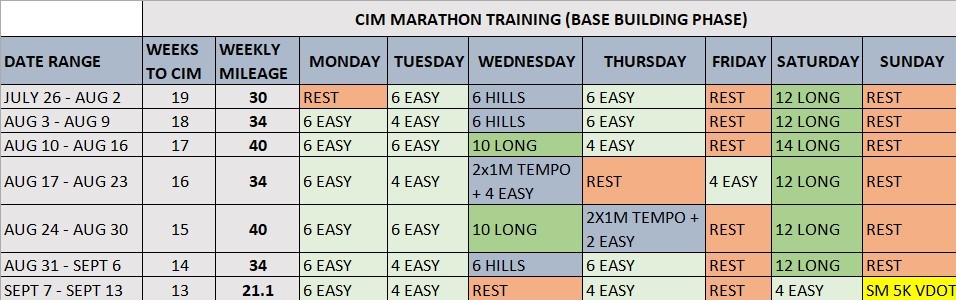
And run I have. After the injury healed I worked running back into my life, primarily by running easy on trails out in the back country I mentioned above. I’ll dig into those in my next post, “The Runs of Summer.” But I’ll leave off today with my current base building schedule, which I am following to prepare me for quality training for a marathon that I can pretty much guarantee is not going to happen: The California International Marathon in Sacramento in December. I’d love it to happen, but I’m not sure if I’m ready to expose my sweating, heaving face (with lungs attached) to dozens of other faces at multiple water stops and a finish line. The thought of all those microbial clouds exchanging billions of tiny little micron-sized droplets bearing a certain SARS variant virus which WILL KILL US ALL (or at least make life profoundly unpleasant if one is lucky) gives me the shivers. And if I’m not careful, it could give me the shakes, the gasps, and the regrets as well. It’s better to be patient than wish one had waited for a few measly months (or years) because after a lung infection, running may no longer be possible at all.

Ever.

My Little Heart Buddy

I’m not old. Really, I’m not. When I was in high school, I perceived that adults just a few decades older than me were old and out of touch. But that couldn’t possibly apply to me.

Right?

Here I am, a “man of a certain age,” if you will, two decades older than most of the adults I knew when I was in high school. At an age of such a towering height that I never thought I’d actually get there back in my sepia toned youth.

Life moves along like a mighty river, doesn’t it?

There comes a point where, after you’ve owned that shiny new car for long enough that the paint begins to fade a bit and the new car smell is a distant memory, that a little red light appears in a previously unnoticed corner of the dashboard where the speedometer lives. It’s called the Check Engine light, and the message behind the persistent little reminder carries a cryptic message. The message is this:

“THE FUTURE IS NOW, M—–F—–!”

There was a brief moment of about eight years duration when I thought I would live forever. Looked about the same, felt about the same, had about the same amount of energy, but over time, little changes made their way through the spiraling DNA that encodes me. I didn’t notice it until one day I realized that I couldn’t read small print on the page. Time to grab a pair of +1.5’s from CVS and accept the fact that I’m my grandmother now. Yikes!

Marathon running has chased back a great deal of the entropy that will eventually encase us all in its comforting coffin, but every once in a while, something slips through. In my case, it was heart palpitations.

Mostly harmless, my primary care physician told me. No doubt your run of the mill stress brought on by the usual suspects: job, city living, social concerns, concerns about the future. Terms like diet modification, self care and meditation were thrown around.

After informing my physician of my family’s history of heart ailments (father and grandfather both passing away from failure of that vital organ), he prescribed a series of tests designed to ferret out how my body is holding up, since I am pretty much halfway and change between birth and the heat death of the Universe.

One of these tests is called a “Holter Monitor,” and it looks exactly like this:

BioTel Patch

The monitor is a chip approximately the size of a USB drive. It is attached to the chest by plugging it into a cartridge which itself is attached to a plastic adhesive patch. Once on the chest, it monitors your heart beats over a two week period. Once the two weeks are up, I will mail the monitor to a processing facility that will download the data and send it along to a cardiologist, who will then forward any findings to my primary care physician.

And I get to wear this thing for two weeks! Yay!

Luckily, since I am in the final training cycle for the California International Marathon, I can wear it while running.

“Of course,” the technician said as he demonstrated how to attach it to my chest, “you can’t really wear this while running.”

“The hell I can’t,” I replied as courteously as I could manage through gritted teeth, “the literature tells me, right here,” (animated gesticulating at the small pamphlet opened on the examination table) “that I can exercise, and even shower with this damn thing glued onto my left pectoral. Of course I’m going to run with it on!”

“How much are you planning on running?” He asked.

I almost told him the truth, which was about eighty miles over the next 14 days. Instead, I said “I’m training for a marathon, so there will be some serious jogging.”

I expected a counter argument, but instead, he congratulated me on my dedication to exercise, and grabbed a handful of extra patches for me to use in case it fell off during my run.

The monitor was attached on a Monday a few weeks back. On Tuesday, I ran six miles at my 8:45 marathon pace with no ill effects, either to me or to the patch.

The next day, Wednesday’s track workout, was the acid test. On tap: after a mile warm up, four one-mile tempo runs at my hard tempo pace of 7:45 per mile. And it was a warm day. I started the workout, tentatively poking at the patch to make sure it was still attached as sweat poured down the front of my shirt.

Midway through my last mile, I felt the patch unglue itself from my chest and fall through my shirt.

I finished the run, carrying the patch in my hand, and drove home. A six mile hill run and a long hilly 12 miler was on my schedule for that week, along with various recovery runs, and I had to figure something out.

After reviewing the directions for applying the patch, I saw the error: the technician did not scrub my chest with soap, rinse it off and let it dry, or shave any hair in the area where the patch was supposed to stick. He did, however, scrub the skin with the included skin pad, but not for the recommended sixty seconds to remove any dead skin.

In his defense, we barely knew each other.

I took one of the replacement pads and after attaching the chip and following all the instructions to the letter, reapplied the chip to the chest site. The monitor stayed where it was applied for the remainder of the week’s runs. However, due to my physical activity, regular removal, skin preparation, and reapplying of the patch was necessary. Applying strips of sweat resistant bandage tape to the sides of the patch helped with my peace of mind, and I’m going to finish the two week period with two patches to spare.

I just wonder what the cardiologist is going to think when she sees my heart rate running all over the place. I guess I’ll find out.

Everything I learned during my base building phase in one word

Consistency.

Long story short, I followed the plan I posted above (well, 85% of it, anyway), including hills, long runs, speed work, and a bit of time off to let the body and mind rest.

Then I put myself through a two week build phase for my VDOT test, the Santa Monica Classic 5k. Ran the Santa Monica Classic 5k, which is a point to point course with approximately two miles of gentle uphill. Finished in 23:25, good enough for 5th place in my age group, and 101st place overall out of 1,500 or so runners. Not sure why I’m throwing those stats in there; most likely a salve to my ego that four years ago I ran the exact same race with the exact same course about 40 seconds faster. But it was a good enough result to tell me that my base building had not been in vain, and that with proper training I can gain all that speed back, and then some.

VDOT: 41. Does that number sound familiar? It should, because it’s the exact same VDOT I started this blog with. But that’s okay (I tell myself, reminding myself to breathe). Positive changes take a bit of time to percolate through the system. And in the meantime, here is what I gained through the base building phase, and where I am now a month into my quality training phase with 10 weeks to go until the California International Marathon in Sacramento on December 8, 2019:

Consistency. Yep, that word again. Consistently following a training plan for a period of time is more valuable than a series of sporadic fits and starts, even if those little run bursts are impressive in their own right. I have a schedule, drawn up by David Levine (of The Idiot’s Guide to Marathon Running fame). That schedule is my running brain. I run what it says, with very little, if any, variation. A VDOT of 41 equates to roughly an 8:30-8:45 marathon pace, which would cut in half the distance between my PR at Mountains 2 Beach and 3:30, my BQ PR minus five full minutes. Consistency in training at a pace congruent to my current ability is 90% of what I need to do to hit my goal.

Flexibility. Fell off the wagon a bit here. Was doing specific stretching for several weeks in a row when when most those niggling running pains disappeared into memory. Slacked off a bit, and wouldn’t you know it? They came roaring back like a bad habit.

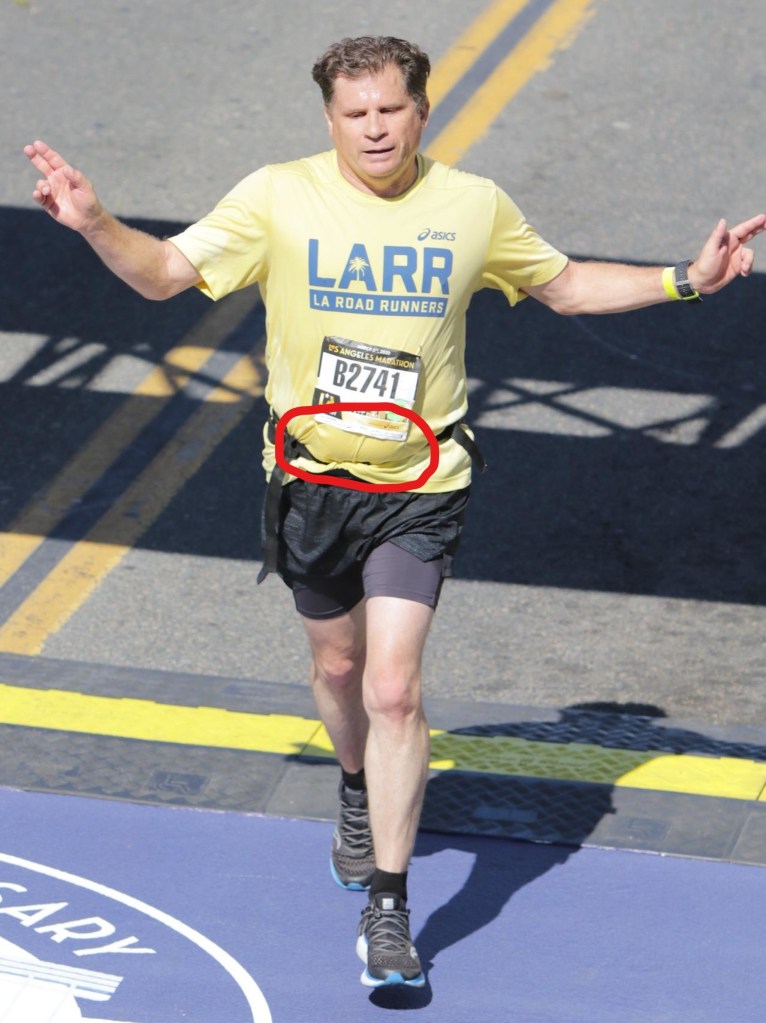
Excess weight: I have ten pounds I can easily lose without trying, without doing more than making a few minor adjustments over the next two months. I’m 5’8″, a bit “thick” (i.e., not whipcord thin), and carry a little bit around the waist I don’t need. No gut to speak of, but I feel it around my torso like a weight belt. I can lose it, easy. Dropping from 180 to 170 pounds will give me more energy and running strength in those last few miles than I can imagine right now.

My “why.” That’s the biggest gain. I know exactly why I want to do this. I know I have it in me to run at least 3:30 in the marathon, which is a five minute cushion of my actual 3:35 Boston qualifying time. I know of too many people who have reached similar goals and crashed through them to think of myself as the lone guy who somehow, for genetic or other reasons, couldn’t pull it off. My ego isn’t that big. All I need to do is put in the work: lots of long, slow mileage to build fitness at the cellular level and increase stamina, most of it during the week on short (4-6 miles) and medium length (7-10) runs, with a long run every weekend. Tempo runs at 30 seconds per mile faster than marathon race pace. Some repetitions to increase turnover. The right foods. Flexibility and rest. And sleep, blessed sleep. Nine hours of it each and every night.

I’m a month into quality training now. Starting Monday, October 7th, I’m going to post my weekly workout, and follow up on how it felt, and how well I did. Flexibility, diet, weight management, it’s all going to be in there. I’ll try to keep it entertaining, but I’m not going to pretend that this blog is going to make history, or even inspire someone who reads it to push through their own personal walls. I’m writing this blog to hold myself accountable. To prove to myself that I can do it. Because I can.

So there.

“You wanted to find out”

Junk food: Eaten!

10 pounds: Gained!

Aerobic Capacity: Lowered!

Leg muscles: Slack!

Motivation: Seriously?

Running break: Accomplished!

Urge to train: …Rising? Maybe?

It’s one of the risks you take when you deliberately take time off from training and allow your body and mind to recover. And it’s not like I was completely lazy. I ran most Saturdays, but easily and socially. I hiked, did a bit of trail running, and even attempted a bit of speedwork.

A total of 55 miles run for the month, more than most non-runners would consider running for a year.

But just like how one looks around while on a two week vacation and says “This is my life now,” completely forgetting about all the real life stuff waiting patiently at home, I fell into the trap of “yep, my running is going just fine!”

And it is, if all I’m I’m trying to get out of running is a weekly social leg stretch and the occasional quick hike down a trail. But I didn’t create this blog with that motivation in mind.

I’m 56 years old, in great health, and I want to know how long and fast I can go with the right kind of dedication and training. Can I qualify for Boston, and perhaps run even faster?

Most importantly, I want to know if I have the fortitude, discipline, and love of the sport to buckle down and do the training in the first place.

And not just the training, but every part of my life connected to the physical effort:

Can I cut the crap out of my diet so I can lose the ten pounds I gained, and then lose 10 more?

Can I spend those hours at home after a hard day at work more efficiently so I can get to bed on time for 8-9 hours of sleep each and every night?

Can I write out a schedule that includes a long morning run, then get up when the alarm tells me to so I can get it done?

Can I commit to a daily flexibility program without it turning into a STAR TREK episode binge watch with token hamstring stretches during the commercial breaks?

Can I practice the self care I need to make sure that my training doesn’t negatively impact my personal relationships, job, and other goals that are just as important as training for a marathon time goal?

And can I maintain these adjustments to attitude and habit long enough to either reach my running goals or come to the conclusion that I simply don’t want it enough?

Nothing wrong with being a recreational runner. Millions of people are. Is that what I truly want?

THAT is my “why.”

THAT is what I want to find out.

Listen to Frank Shorter ask Meb Keflezighi about the strategy he used to win the Boston Marathon in 2014. Listen to Meb’s answer and Frank’s response. That is the essence of the question I am asking myself.

https://www.youtube.com/watch?v=CVjt5yBte4o&t=0m41s

The California International Marathon is five months hence, to the day. I created a base building training schedule for July and August designed to get me ready for the three months of quality training necessary to get me to the start line on Sunday, December 8th, 2019 with a reasonable shot of hitting a specific time. With the exception of four miles of repetitions and intervals, it is all easy running. Part of me thinks I’m being a bit too easy on myself with this schedule, but it is designed specifically to leave me with no excuses. Is a marathon time goal something I want, or not?

Long before I reach the end of this schedule, I’ll have my answer.

Training When Life Gets Hard

Jobs. Family responsibilities. Car trouble. Time commitments made but then forgotten. Bad weather. Then even worse weather.

Lack of motivation, depression, anxiety, regret, loss, lack of sleep, overall lack of energy due to the constant grinding of life against one’s limited physical, mental, social and spiritual resources.

#Amirite?

Still gotta train, though!

It’s been several months since my last entry, and I apologize. But, you know, stuff.

So, where am I at? Right now, I’m in a pretty good place.

A little backstory:

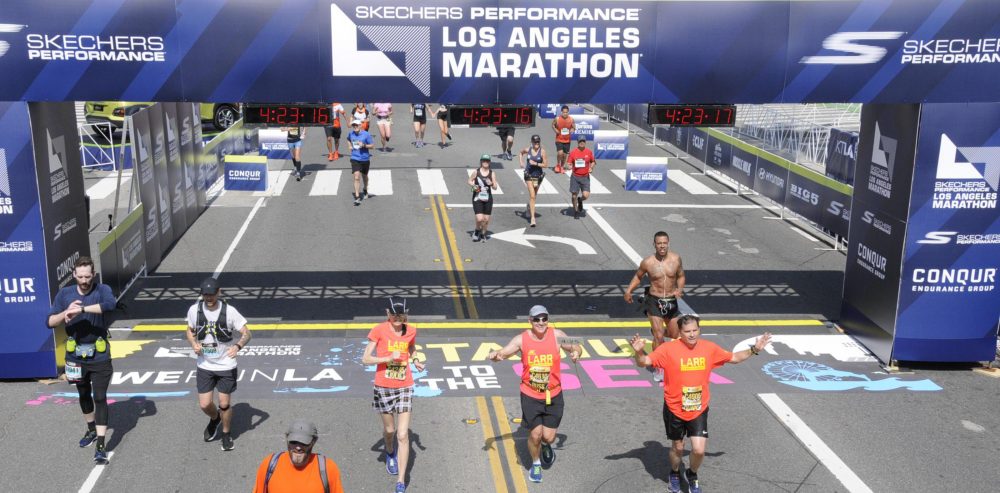
I am a pace leader for the LA Roadrunners running club, the official training program for the LA Marathon. Which means that every Saturday morning from September through Marathon Day in March, rain or shine, I rise at oh-dark-thirty in the blessed ayem, a full ninety minutes earlier than I do for my day job, slam as much of a healthy breakfast as I can down my pie-hole, and drive to Marina Del Rey to meet several hundred runners who depend on me and about ninety other “PL’s” who have made the same commitment, and lead them on long training runs around Marina Del Rey and up into Santa Monica. Along the way, we provide coaching, encouragement, friendship and at times a bit of therapy as we make our way along sidewalks, beach paths and the occasional shoulderless stretch of roadway on our 10,12,14,16,18,and 20+ mile runs.

I pace a group corporately named “Run Group 6,” which means we run 11 minute miles on these long runs as part of training for a 10 minute per mile marathon pace. Which means that as the calendar falls headlong into the throat of winter, we spend a increasingly long amount of time in each others’ company. In the case of our longest run coming later next month, that time will be around three hours and forty minutes.

These runs are always done with the idea that suffering together creates a diverting, relaxed congenial atmosphere. Running as a social lubricant.

It also means that as pace leaders, we are expected to be  stronger runners than the runners we are leading. Can’t do that if you are suffering as much as the runners under your care.

Need a motivation to train? There you go!

Because when the actual race gets tough, as it always does around mile 18, we are the ones our fellow runners will look to for encouragement and motivation. And we need to be in a position to provide it.

Life got a bit rough for me during the holidays late last year, and it was tempting to let things slide and just sleep in on the weekday mornings, and surrender to MASH and Star Trek reruns in the evening after work. And a few times, laziness won out. But overall, knowing what will be expected of me at the LA Marathon pushed me out the door. And oddly enough, who’da thought, running can lift burdens and provide much needed perspective on non-running aspects of my existence.

Life evened out after the new year, and I surprised myself with the realization that I ran twenty miles more in January this year than January last. It was a major accomplishment.

But then, oddly enough, it began to rain in Los Angeles. A lot.

And right about that time, my car needed some much needed attention, requiring me to take “alternate transportation” to that all important day job.

The bike.

Not the motorized kind, mind you. The regular kind. The kind that you have to pedal in order to push through the rain.

So for several days, I donned all the rain gear I could find and biked through the sloppy wet streets in a downpour to the Expo line train station, rode the train as close to my work as I could, then pedaled the rest of the way there. A change into some dry socks and shoes, and I was good to face the workday. Then, at five pm, re-don the wet shoes and socks and lather, rinse, repeat to home.

Life happens, right?

Like when the derailleur on your back wheel gives out just as you decide to pedal your way through a six inch pool of standing water a hundred yards long, as the uncaring automobiles slide past you sending little tsunamis up and over your calves, your rain gear now useless because God chose that moment to give you a demonstration of what old man Noah must have gone through back in the day, and when you get home, you end up dragging half the puddle you pushed through all over and into the new carpeting your landlord installed as a justification for the rent increase.

And you’re going to towel off, don your running clothes, turn around and do a six mile hill workout after all that?

Hello Hawkeye, Trapper and Frank Burns. What are you up to this fine evening? I’m sorry, but I’m not that strong.

Besides, I will have to _walk_ to the train station tomorrow morning because the garage had to send out for a part that will take a full day to get to them so they can install it. Oh boy.

But take heart, friends. I’m going to pull this off. Here’s how:


According to my training log, I ran 180 miles from January 1st of this year to yesterday morning. Was shooting for around 220, but considering everything, I’ll take it.

With four weeks of training “build” and a two week taper before the marathon, I will be running my highest mileage weeks, and I feel strong, and mentally and physically ready to push through whatever training, and life, throws at me.

The greatest decision I made this training cycle was to NOT overlook the LA Marathon on the way to Mountains 2 Beach, my BQ race. Of course, I’m training for both, but I am approaching the LA Marathon as a separate race entirely: I am training _specifically_ to run the LA Marathon at 8:45 per mile pace, or in a 3:50 finish time.

Of course, as a pace leader for LARR Run 6, I won’t be running the marathon at that pace. I will lead my group to a 4:22 finish, running 10 minute miles. And by focusing specifically on the LA Marathon and training to run it at a full half hour faster, I will have the strength and perseverance to help as many runners as possible reach their goal of finishing the marathon in 4:22 or better.

Because life is challenging for everyone. And how do we find respite from our challenges? By challenging ourselves to accomplish something we once thought impossible, and having a little fun along the way.
My goal, and what it’s going to take to reach it

Long story short: I want to qualify to run the Boston Marathon. My current marathon PR is 4:10, and I need to run under 3:35(*) in order to reach it. My goal: knock 40 minutes off my current time at the Mountains to Beach marathon on Memorial Day weekend in 2019, seven and a half months from now, crossing the finish line with enough cushion to guarantee myself a spot (I’m gunning for an arbitrary five minutes). Oh yeah, and hit the gong in triumph.

Sounds good. It’s a meaningful goal.

However, at this time it’s fantasy. Here’s why.

Until recently, my marathon training history consisted of training to run the fastest pace I could reasonably hope for with as few miles as I felt I could get away with.

This is not an admission of laziness. No one takes up distance running because they don’t want to push themselves. It is, rather, an admission of lack of time management, ignorance of basic marathon training principles, and an unwillingness to tolerate discomfort and pain beyond a certain threshold.

Back when I was running in order to chase away depression, anxiety and self doubt brought on by the Great Recession, I ran through remote portions of Yosemite National Park, the San Rafael and Dick Smith Wildernesses, Big Sur, the Sierra Nevadas, and anywhere else that would yank me out of the head-space I was in that told me my most productive years had passed me by. It worked, and it provided me with a solid base that powered my first 10k and half marathon races. Make no mistake; my fitness has improved. I can run at a 9:45 pace until I either drop dead or run out of road. I would not be able to do this if I hadn’t pushed myself in my previous training. But this new goal is going to require me to change the way I train.

After all, my recent time at the Ventura Half Marathon tells me that I am capable of training to run a marathon in three hours and fifty minutes. So why is my PR a full twenty minutes slower?

More on this in the next post.

But in the meantime, I have some pre-work that needs to be done. It’s one thing to commit to a new way of marathon training, or to any new worthwhile endeavor; it’s another to take a hard look at the non-running parts of my life and make the changes necessary so that new goals can take root and flourish. To wit:

  1. Get to bed early enough to sleep the 8-9 hours I know I will need in order to recuperate from my efforts.
  2. Take the time to plan my food needs and shop weekly (which has the added benefit of saving money otherwise spent eating out)
  3. Clean and organize my living space so I don’t allow messy surroundings to influence my mood and desire to train.
  4. Plan my downtime to really recreate and unwind. Watching Star Trek and MASH reruns is occasionally acceptable, but it can’t be my default position every time I’m tired and bored.
  5. Understand that I will need to get out the door and train regardless of how tired or stressed I feel. A friend and coach I know uses the mantra “No excuses.” I need to find one that works for me.(**)
  6. Perhaps the most important thing: understand that I run because I enjoy running. It’s what I do to unwind and recreate, and as such falls under the definition of self care. There will be a “job” aspect attached to this specific goal, but “resting and recreating” can apply even to the hard workouts. After all, at least I’m not at the office.

Life is short, and no one knows for sure what lies on the other side of it, so we need to make do with the opportunities we have before us right now, and we need to have the courage to face the uncomfortable transitions between what we have settled for, and what we dream of in those moments when we wish for a better life.

Which is why this blog exists.

(*) The new BAA qualifying standard for a male 55 years of age is 3:35. I will need to run faster than that time to have a chance to actually enter the race in April of 2020.

(**)A writer of my acquaintance once told the story of another writer he knew who would, every morning upon waking, point a loaded pistol to his head and ask himself “Are you going to get up and write today?” I don’t think such a tactic would necessarily apply to me, but who knows?

Defeat, and the agony thereof

It’s all my dad’s fault, really.

I grew up in a small town called Heber, Arizona.(*) It was (and still is) a friendly place on the outskirts of the Mogollon Rim, populated with juniper, ponderosa pines and decent, wholesome people.

I struggled to fit in. My interests did not include football, baseball, or any sport that I could think of at the time that my friends and fellow townspeople valued. Instead, I favored reading: Jack London’s Klondike adventures, science fiction’s great authors like Asimov, Bester, Ellison, Silverberg and Bradbury. I had plenty of time to read them all on the thirty mile bus ride to Snowflake High School in the town of the same name, shutting myself off from the adolescent drama that played out between all of us on that 45 minute ride. I spent evenings with my small telescope staring up at the universe. I was probably the only person in a hundred mile radius who knew who Carl Sagan was. Yeah, I was that kid.

So playing on the church softball team with other kids my age didn’t fit into my priorities. But my folks, being wiser than I, knew that I would really regret not playing on the softball team, and I, being far more naive than I could imagine, knew they were right.

I played, I got better, and I began to feel more accepted.

However, one day after striking out the three times I was at bat, I came home and told my dad that I wanted to quit the team. He looked at me and said, “one of the coaches (he named the coach) told me that you are an incredible runner, that when you get a hit, you fly around those bases.”

That stuck with me. I was actually good at something my friends and other adults valued. I couldn’t hit for beans (though that skill improved as I edged further into adolescence), but I could run.

I joined the track team my sophomore year in high school.

I focused on the 100 and 200 meter dashes and the long jump, since we didn’t have a “real” cross country program. Surprised myself that first year by clearing 14 feet in the long jump, and earning 0.5 points toward the eight points needed to letter.

Grew stronger in my junior year. Found some speed and ran the 200 meter dash and the 1600 meter relay, cleared 18 feet in the long jump, and lettered easily with 12 points. In my senior year, I cleared 20 feet twice, winning my favorite event outright several times and anchored the final 400 meter leg of the 1600 meter relay. Earned 72 points, lettered again, and said to myself at the district finals, “I’m going to the State Championships! This is going to be SO AWESOME!” And therein lies a tale.

My friend and fellow teammate Jeff Flake(**) occasionally joined me in the long jump. I was holding onto third place with a single inch advantage, and our coach gave him the chance to perform the event since my other long jump teammate decided to drop out of the event at the last minute.

He performed his first jump, and I died inside. He beat me by two inches, knocking me into fourth place, and out of a place in the state championships.

I was crushed, but I knew we had the 1600 meter relay coming up that evening, so I prepared myself, kept warm, and promised myself that a finish that guaranteed a place at state would make it all worthwhile.

Then the other shoe dropped. The 1,600 meter relay was to be run in two heats. The slower teams would run first, and the faster teams would run second. Fine. But despite coming to the district finals ranked first in our division in the event, some dimwitted official placed us with the slower teams.

I was running the anchor, or last, leg. By the time I got the baton, we were a full 200 meters ahead of the second place team in the heat.

I ran my guts out, finishing with a 54.9 second split time for the final 400 meters, but it wasn’t enough. Because we weren’t racing with the faster teams, we had no idea if we would eventually finish in the top three. And it gave those faster teams a target to gun for. And gun for it, they did.

We missed going to the state finals by 2.5 seconds, a gap we would have easily closed if we would have raced against the faster teams like we knew we were supposed to.

I locked myself in a bathroom stall and bawled my eyes out. It was my senior year, and despite all my hard work, despite all I had gained thanks to my dad pushing me out of my comfort zone, I would never make it to the State championships. My running career was over.

Later on, I realized that finishing high school was the end of the beginning of my life, and that in time I would become a much better runner than I ever imagined, and that I could push myself in ways I thought impossible when I was a high school senior. I could work for and achieve much bigger running goals.

But despite the fact that over thirty years have passed since that fateful day, my hands still tremble as I write this.

(*) Heber-Overgaard, Arizona, between Payson and Showlow on Arizona Highway 260. Population about 2,800 as I write this. A perfect place to grow up, though I didn’t realize it at the time.

(**) Yes, that Jeff Flake, the Senator from Arizona. Abysmal politics, but a decent guy. He actually apologized to me for edging me out of the state finals after the event.

Jesus Hill

LA Marathon 2014 Mile 21

Date? March 23, 2014.

Place? Just off Ohio Avenue in West Los Angeles, on the main road that snakes its way through the sprawling VA Hospital complex. Specifically, mile marker 21 of the Los Angeles Marathon, just before the Wilshire Blvd under crossing that begins the short but brutal ascent named after a century old wooden chapel that sits at the top of the hill.

Jesus Hill.

Time? Around 10:00 AM, give or take.

Situation? My second ever full length marathon, and I vowed that it would be my last.

The temperature at the start line was a balmy 70 degrees, and that was before the Sun came up. Our LA Road Runners pace leader, a multiple Iron Man veteran named Adrian, had warned us earlier in the week that despite hope that the heat wave would moderate in time for Sunday’s race, heat was the most likely condition we would encounter on race day.

He was not wrong.

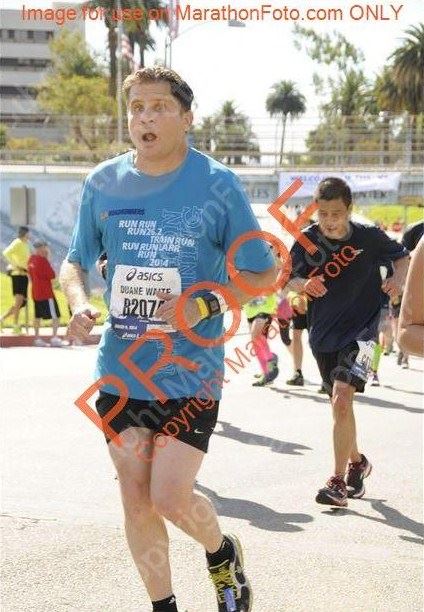
The attached photograph shows me doing my best to keep a stiff upper lip by clowning for the race photographer as we all struggled up Jesus Hill. But inside, I was dying. Physically, mentally and emotionally. The temperature hovered somewhere in the mid eighties. I was out of water, and not sure I could even hold any down should it be offered to me at the despairingly few water stops along the last 5 miles of the course.

The previous year, during my first ever marathon, I wondered if I was, in fact, dying as I crested the hill and turned left toward San Vicente Blvd and the Mile 22 marker. No, I wasn’t dying, though I didn’t remember feeling as physically exhausted since a recent flu that kept me bedridden for a week. I was merely bonking.

But now, I think I was. I had never experienced the pain of pushing my body past its breaking point before, but I was suffering up that infamous hill again, telling myself that a mile and a half lay between me and the surely cooling ocean breezes that would no doubt greet all of us as we descended to the finish line on Ocean Avenue.

The breeze never came. Instead, I gave way to the pain and began to walk, my anger rising by the minute because I wouldn’t break four hours in the marathon, and because walking hurt just as much as running did. And that I still preferred walking.

I finished the 2014 edition of the Los Angeles Marathon in 4:14 and change, a minute slower than my first ever effort. I grabbed a water bottle and drained its contents, allowed a sympathetic volunteer to drape a medal over my neck, and then grabbed an ice towel and wept into it for five clock minutes.

As I slowly rode my bike home (just a few miles from the finish), I began to think two thoughts:

  • I probably would have done better if it wasn’t so hot, and
  • I’ll bet I can do better next year.

Because reason #3: I’m an idiot.